Australia’s 15% CGT Concession for Foreign Renewables Investors Extended to 2040
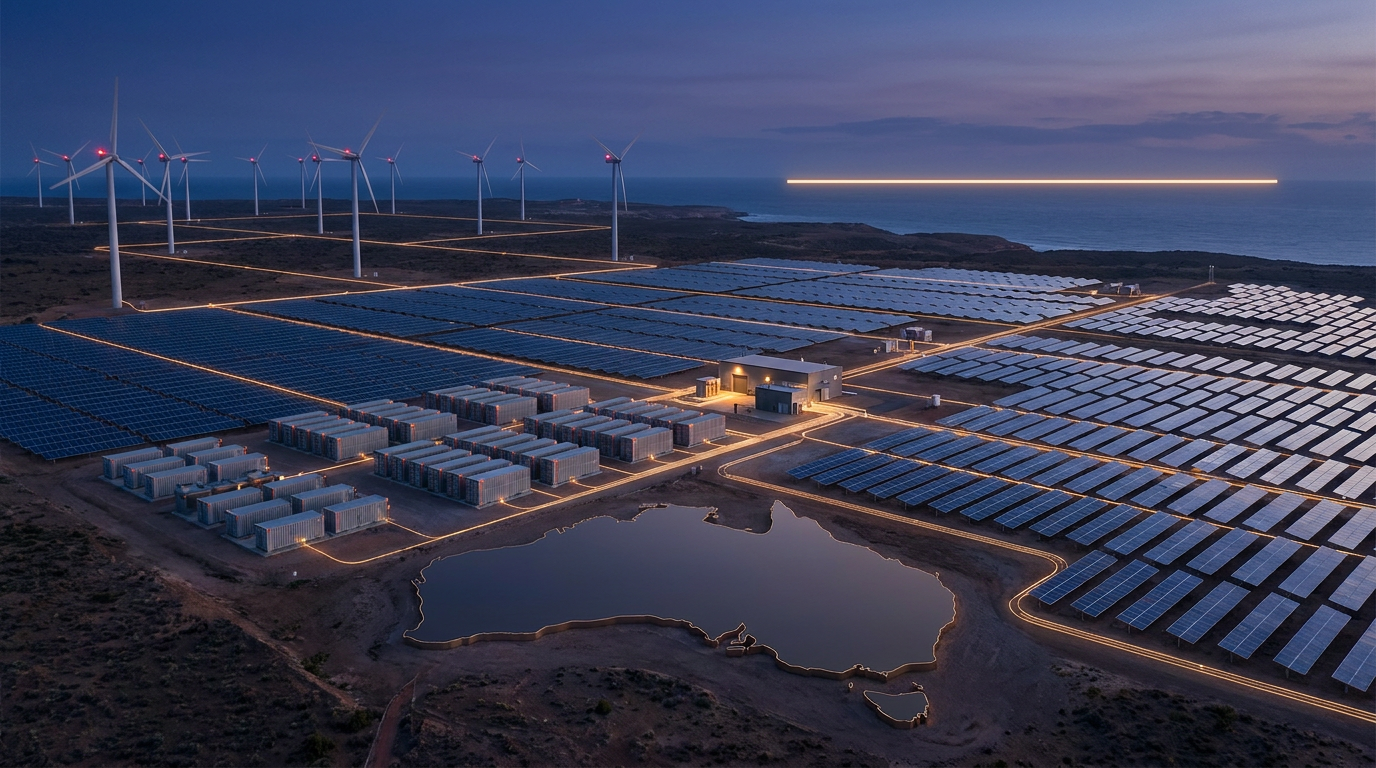
Original illustration created for RenewaNews.

Australia's 50% CGT Discount for Foreign Renewables Investors Extended to 2040
Australia's Treasury confirmed on August 20 that the government had passed amendments extending to June 30, 2040, a concessional capital gains tax treatment for foreign investors in wind, solar and battery storage projects, up from an original 2030 sunset date. Treasurer Jim Chalmers credited the ten-year extension to the "constructive role of the Greens and other members of the crossbench," according to a statement from Treasury Ministers of Australia published the same day.
The concession sits inside a much larger overhaul of the foreign resident capital gains tax regime, and that overhaul is the reason the extension mattered enough to draw a deal with the Greens in the first place.
What actually changed — and which number applies to what
The underlying bill broadens the definition of "taxable Australian real property" to capture assets with a close economic connection to land, a category that sweeps in renewable energy infrastructure that previously sat outside the foreign CGT net, according to EY's July 10 technical briefing on the Treasury Laws Amendment Bill 2026. That briefing describes the instrument being extended as a "targeted, time-limited 50% capital gains tax concession," and Independent MP Nicolette Boele, in a parliamentary speech recorded August 20, confirmed the government had extended "the 50% discount window to 2040" as what she called "a welcome compromise." PV Tech's August 21 report likewise describes "the 50% discount on CGT liability for foreign investors" running to 2040.
A separate legal briefing from MinterEllison, published May 4, describes a different mechanism entirely: a new 365-day market value test for indirect interests, and a 15% foreign resident capital gains withholding rate. That briefing ties the A$50 million threshold to the withholding rate itself. The Australian Taxation Office's guidance of July 16, 2026 states that the 15% withholding applies to all taxable Australian real property, and that A$50 million instead marks the threshold for a separate mandatory notification requirement — meaning the MinterEllison briefing conflates two distinct provisions from the same reform package.
How close the deadline actually was
Before the amendment, the concessional treatment was due to expire in 2030 — inside the construction and early-operations window for a large share of Australia's pipeline. Boele told Parliament that industry had been "staring down a fire sale of renewable assets before 2030" under the original timeline, a framing reported by RenewEconomy on August 20. Clean Energy Investor Group chief executive Richie Merzian, quoted in the same RenewEconomy report, said the 2030 cutoff would have sent the "opposite of the message we want to send" on investment stability.
That is the commercial logic behind the ten-year extension: a project financed in 2027 with a 20-year offtake horizon would have faced a tax cliff mid-life under the original deadline, forcing sponsors to underwrite an exit or refinancing event that had nothing to do with power markets. The Investor Group on Climate Change, in an August 20 release, cited modelling from Mandala Partners as showing the extension reduces what IGCC policy director Frankie Muskovic called the "chilling effect" of the new tax, though neither the release nor the modelling as cited gives a figure for the size of that reduction. Muskovic said the extension "removes an element of uncertainty for investors at a time we need to supercharge investment."
Why the Greens had leverage
Every account of the negotiation names the same counterparty. Clean Energy Council chief executive Jackie Trad said in an August 20 statement that the deal was reached through negotiations between the government and Greens senator Nick McKim, and called the 2040 date a "long term signal that aligns with project development and planning timelines." Trad also made the capital-scarcity argument explicit, noting Australia's "relatively small pool of local capital" leaves the country dependent on foreign equity to build new generation.
Independent MP Zali Steggall put a number on that dependence in an August 20 statement from her office, saying "around 70 per cent of clean energy capital comes from foreign sources." Her office did not name an underlying study for that figure; it is presented here as Steggall's own claim, not as independently verified investment data. Steggall argued the 2040 transition "recognises the realities of financing and building renewable energy infrastructure," and flagged that she intends to push for a statutory review in 2035 to determine whether a further extension is needed to stay on track for 2050 net-zero targets — meaning the industry has bought fourteen years of certainty, not permanence.
The domestic backlash
The extension has not been received as a clean win inside Australia. News.com.au reported on August 20 that the same legislative package scraps the general 50% CGT discount for domestic investors even as it locks in concessional treatment for foreign renewables capital, a split that Stockspot founder Chris Brycki, quoted in that report, called a "wrecking ball" for the broader economy. Foreign capital in wind, solar and storage gets a decade-long carve-out at the same moment ordinary Australian investors lose a long-standing discount elsewhere in the tax code.
PV Tech's August 21 coverage frames the concession as one that "softens a broader package of CGT reforms" first floated in the 2024-25 budget, and notes that the original draft legislation had proposed applying the broadened rules retrospectively to 2006, a provision abandoned after what the outlet describes as industry pressure. That retrospectivity threat, more than the headline concession itself, appears to be what actually spooked existing foreign holders of Australian renewable assets, since it would have reached back through transactions already priced and closed.
What this means for capital allocation
For sponsors underwriting new Australian wind, solar or storage deals, the practical outcome is that the tax treatment assumed at financial close in, say, 2028 now survives to project maturity rather than expiring mid-hold. That removes a variable that infrastructure funds and pension allocators price explicitly into exit assumptions: the risk of a CGT step-up landing before an asset reaches steady-state cash flow.
It does not remove the underlying fact that the tax base itself has widened. Boele's point stands: a foreign investor selling an Australian renewables asset after 2040, or one structured outside the concession's scope, faces a regime that captures more transactions than it did before this bill passed.
What is documented is narrower and still useful: the deadline that mattered to financing timelines has moved from 2030 to 2040, the retrospective threat to 2006 has been withdrawn, and a statutory review is scheduled for 2035 that will determine whether this is a decade of certainty or the first stage of a longer negotiation. Whether the widened definition of taxable Australian real property catches existing special-purpose vehicles already holding Australian renewable assets, the question a fund's tax counsel would need answered before closing a new deal, is not addressed in any of the statements or briefings issued around the August 20 vote.
Sources
This article was reported from the following sources.
Legislation to strengthen the tax system passes the House — Treasury Ministers of Australia, 2026-08-20
Investment certainty greatly improved following Capital Gains Tax agreement in the Senate — Clean Energy Council, 2026-08-20
Wind and solar investors relieved after Greens and cross-bench win 10-year reprieve on new tax on renewables — RenewEconomy, 2026-08-20
Investors welcome extended transition for new capital gains tax on renewable energy projects — Investor Group on Climate Change (IGCC), 2026-08-20
Australia extends capital gains tax concession for foreign renewables investors to 2040 — PV Tech, 2026-08-21
Crossbench secures 2040 deadline for renewable energy CGT concessions — Zali Steggall MP Official Site, 2026-08-20
CGT row: Foreign investors offered 15 per cent rate while Aussies lose discount — news.com.au, 2026-08-20
CGT changes for foreign investments in Australian land and resources — MinterEllison, 2026-05-04
Tax and foreign investment's impact on renewables — Nicolette Boele MP (Hansard/Speech), 2026-08-20
All source links verified at time of publish.