Canada’s $70 Billion Hydro-Wind Package Lands While U.S. Interconnection Queues Stall at 2,600 GW
Original illustration created for RenewaNews.

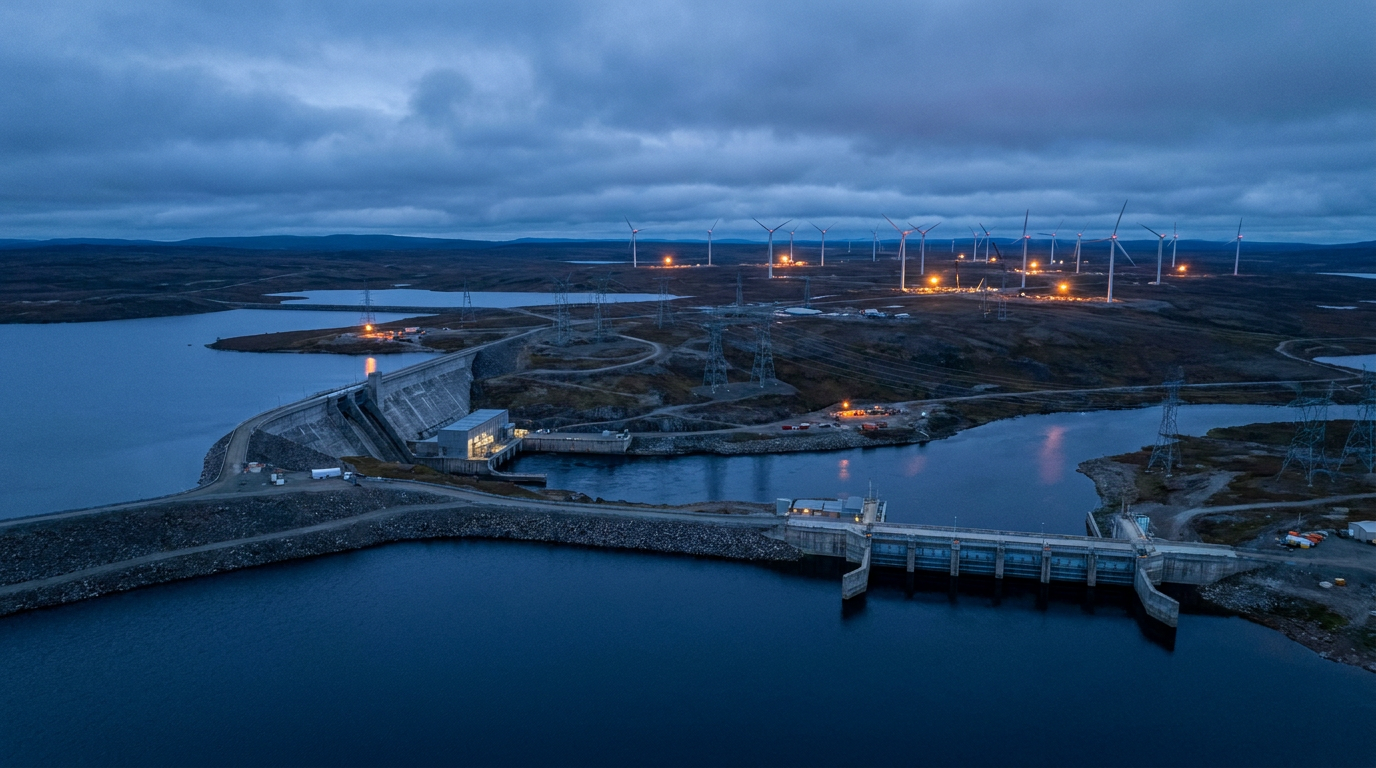
Prime Minister Mark Carney stood with the premiers of Newfoundland and Labrador and Québec on August 17 to announce what his government calls the largest clean energy investment in North American history: a nearly $70 billion package built around Churchill Falls, a new Gull Island hydro station, and a Labrador wind build-out, projected to add up to 14,000 megawatts of generating capacity through the early 2040s, according to Canada.ca and the trade newsletter cCarbon, both dated August 17-18, 2026.
Carney told reporters the combined output would be "more than the entire generating capacity of B.C. Hydro" and "more than double the output of Bruce Power," comparisons captured in APTN News coverage of the announcement on August 18, 2026. Those are the kind of scale references utilities elsewhere use when they need political cover to defer 14,000 MW of firm hydro against demand growth they can't yet fully quantify.
What's actually in the package
The headline number breaks into pieces. Gull Island is a new 2,700 MW hydroelectric project. Churchill Falls itself gets an upgrade — the Canadian Waterpower Association, in an August 21 explainer, put that increase at 1,275 MW, nearly tripling the station's current output when combined with existing generation. A Labrador onshore wind component adds roughly 2,000 MW, per APTN's August 18 report, though the newsletter Clean the Sky put the same category at 2 GW and described the Churchill Falls upgrade as "up to 2.5 GW" in its August 20 write-up — a gap from the Waterpower Association's 1,275 MW figure that no single document resolves. Readers modeling firm-capacity additions should treat the upgrade number as contested until Ottawa or Hydro-Québec publishes a reconciled figure.
Federal financing runs to $10 billion, structured to include a loan guarantee specifically for Gull Island, according to the Canadian Waterpower Association's August 21 account. That guarantee matters more than the headline dollar figure: it signals Ottawa is willing to backstop construction risk on a project that hasn't reached financial close. Definitive agreements are targeted for December 31, 2026, the same source notes — meaning the $70 billion figure describes a negotiated framework, not a financed project.
The commercial structure sits on top of a genuine legal reset. EnergyNow.ca reported on August 17 that the Newfoundland and Labrador and Québec premiers signed a Definitive Cooperation and Implementation Agreement establishing a new 50-year transmission and generation contract, replacing the 1969 Churchill Falls Contract that has shaped Labrador hydro economics — and the province's grievances over it — for more than half a century.
Jobs and GDP claims, and their limits
Ottawa's economic case rests on two figures repeated across the government's own release and EIN Presswire's parallel August 17 filing: 23,000 jobs and $31 billion in GDP contribution through the early 2040s. Both numbers come from the same announcement cycle and appear nowhere independently verified — no third-party economic modeling has yet been published to test them. That's a gap worth flagging for anyone underwriting regional labor or supply-chain plays off this deal.
The AI demand backdrop
None of this is happening in a vacuum. Canada's data center development pipeline now exceeds existing grid capacity by more than fourteen times, according to CVCA Central's May 13, 2026 analysis, which also noted that AI facilities need continuous power that wind and solar alone cannot supply. Digital Journal, in an August 2, 2026 piece on Canada's AI ambitions, described the federal government explicitly linking AI development to its proposed National Electricity Strategy, including transmission upgrades and inter-provincial connections.
Québec has already committed to its own build-out independent of the Labrador deal. Its 2026-2050 integrated energy resource plan targets roughly $87 billion in investment and nearly 150 TWh of new renewable capacity, with wind reaching 21-25 GW and solar up to 5 GW by 2050, according to a July 14, 2026 analysis from Borden Ladner Gervais published on Mondaq. Hydro-Québec is tasked with adding about 100 TWh of new supply on its own. The Labrador package and Québec's provincial plan are separate financial commitments that happen to point the same direction — firming capacity ahead of load growth nobody can precisely size yet.
Where Canada's queue discipline shows up
The contrast with U.S. interconnection is stark on the numbers available. Interconnection.fyi, tracking 44,020 queue requests across U.S. and Canadian grid operators as of August 24, 2026, shows Hydro-Québec carrying just 81 projects in its interconnection queue, against 1,088 for Ontario's IESO. South of the border, the U.S. backlog has swelled to roughly 2,600 GW, with median time to commercial operation approaching five years and data center interconnections facing delays of up to 12 years, according to an August 24, 2026 analysis from Enki AI — a single source for a figure this consequential, and one worth treating as directional rather than definitive until a grid operator or FERC dataset confirms it independently. The same analysis put grid-upgrade costs at 30-37% of total project budgets and pegged the withdrawal rate for new interconnection requests near 80%.
Hydro-Québec's cross-border export ambitions predate this announcement. Serge Abergel, chief operating officer of Hydro-Québec Energy Services, told BloombergNEF in an April 20, 2023 interview that Québec's hydro reservoirs can function as a "battery" for intermittent renewables feeding into New York's grid through the $6 billion Champlain Hudson Power Express line, which was expected to begin commercial exports by May 2026. Abergel also flagged frustration with the pace of U.S. grid approvals — a complaint that reads differently three years later, with the domestic Labrador deal moving through federal financing commitments in a matter of weeks rather than years.
Hydrogen's slower parallel track
Not every Atlantic Canada clean-energy bet is accelerating at the same speed. The European Union approved €200 million in early 2026 to support Canadian renewable hydrogen exports to Germany, unlocking matching federal funds, according to The Energy Mix's February 2, 2026 report — with supplier auctions not scheduled until 2027. But Newfoundland and Labrador's broader hydrogen pipeline has thinned considerably. EnergyNow.ca reported on August 23, 2026 that only two projects remain active: Exploits Valley Renewable Energy Corporation, which is targeting a final investment decision in the first quarter of 2027 for a 3.5 GW wind and 2.6 GW hydrogen/ammonia complex, and North Atlantic Group's smaller 324 MW wind project feeding two hydrogenation plants aimed at 90,000 tonnes of annual hydrogen output for European export.
That gap between a $70 billion hydro-wind package moving from announcement to federal financing commitment in under a week and a hydrogen sector still waiting on a single FID eighteen months after its EU funding cleared is the clearest measure of where Atlantic Canada's capital is actually concentrating. Firm hydro with a 50-year contract structure and a loan guarantee attached is bankable in a way that export-dependent hydrogen, still short of offtake certainty, is not.
Sources
This article was reported from the following sources.
- Prime Minister Carney announces the largest clean energy investment in North American history — Canada.ca, 2026-08-17
- Canada Announces $70 Billion Clean Energy Investment To Deliver 14 GW Of New Renewable Power — cCarbon, 2026-08-18
- Canada unveils $70B clean energy project, the largest in North American history — Qazinform News Agency, 2026-08-18
- Churchill Falls and Gull Island: What this landmark agreement means for Canada's energy future — Canadian Waterpower Association, 2026-08-21
- Prime Minister Carney announces the largest clean energy investment in North American history — EIN Presswire, 2026-08-17
- Canada unveils $70 bn clean energy investment in hydro projects — Fibre2Fashion, 2026-08-19
- Hydro Investment Deals — Clean the Sky, 2026-08-20
- A New Chapter for Newfoundland and Labrador's Electricity System — EnergyNow.ca, 2026-08-17
- Largest clean energy investment in North American history with new tentative agreement — APTN News (YouTube), 2026-08-18
- Canada's AI ambitions face an energy reality: Can the grid keep up? — Digital Journal, 2026-08-02
- Rethinking power for Canada's AI boom — CVCA Central, 2026-05-13
- U.S. and Canada Interconnection Queue Projects — Interconnection.fyi by GridTracker, 2026-08-24
- Grid Interconnection Delays 2026: A Threat to US Energy — Enki AI, 2026-08-24
- Green hydrogen in Canada: Progress, promise, and pressure in 2026 — Digital Journal, 2026-08-23
- Atlantic Hydrogen Firms Welcome $200M in German Investment — The Energy Mix, 2026-02-02
- Newfoundland and Labrador's Big Plans for Hydrogen Dwindle to Two Projects — EnergyNow.ca, 2026-08-23
- Powering Canada's AI Future: Electricity, Policy, and the Race for Data Center Leadership — Conference of Montreal 2026 (YouTube), 2026-07-13
- Québec's 2026–2050 integrated energy resource plan: Capital build-out, timelines, and market opportunities — Borden Ladner Gervais LLP (Mondaq), 2026-07-14
- Hydro-Québec's $6 Billion New York Line on Track for 2026 Start — BloombergNEF, 2023-04-20
- Churchill Falls is more than an energy deal. It's where innovation fuels nation-building prosperity — iPolitics, 2026-08-25