
Battery storage reaches 52 GW as renewable projects advance in the U.S. and abroad
Sunday, August 16, 2026
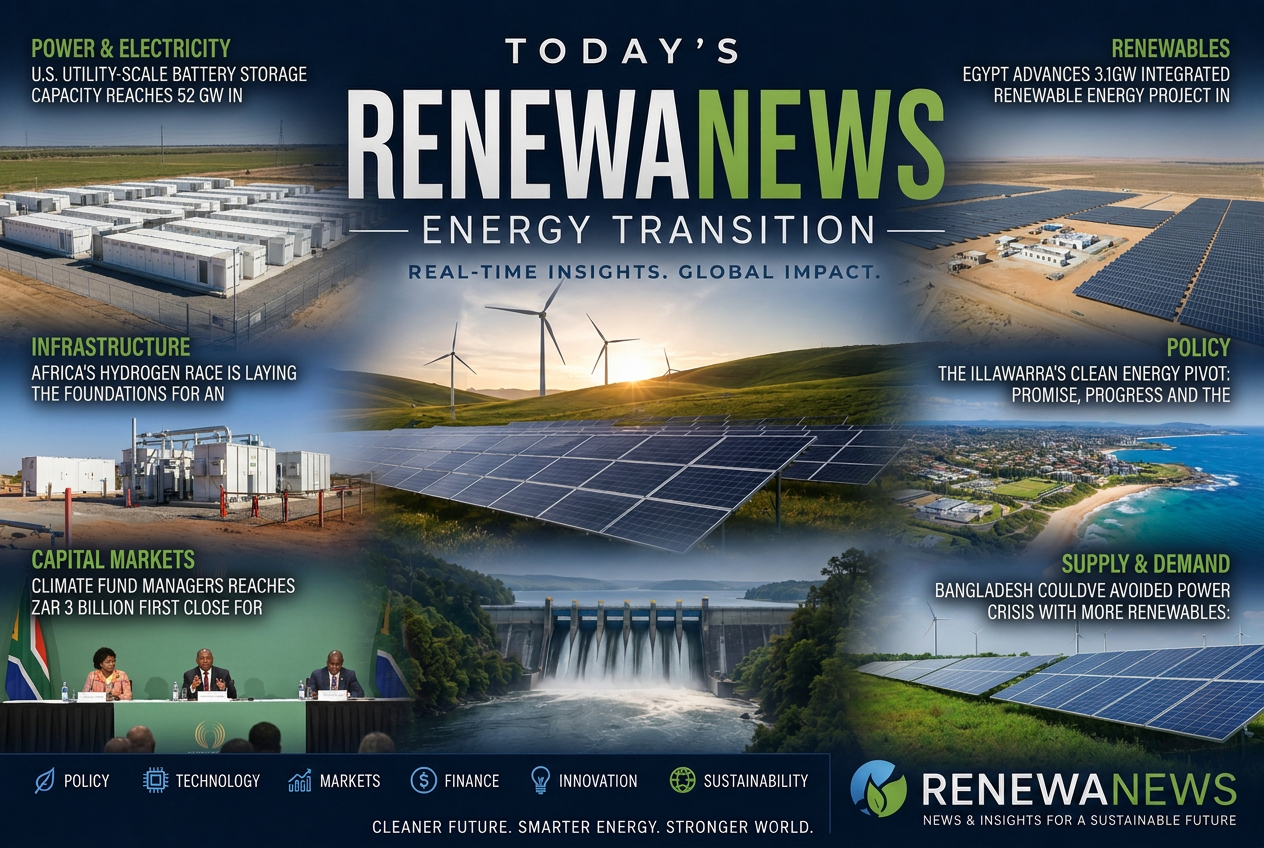
U.S. utility-scale battery storage capacity reached 52 GW in mid-2026, averaging 70% annual growth over three years. Elsewhere, headlines point to continued renewable and hydrogen project development in Egypt, Oman, Scotland, and Saudi Arabia, alongside policy and grid challenges in Louisiana, Bangladesh, and New Zealand.
Midstream
Rapid utility-scale battery buildout signals stronger competition for grid storage investment and a larger role for power-flexibility assets in managing renewable integration and peak demand. For oil and gas executives, it is a reminder that capital is continuing to flow toward electrification infrastructure that can influence load growth, power prices, and long-term fuel demand.
Energies Media
This signals continued policy and research support for grid-forming batteries, which are becoming important for maintaining system strength as renewable penetration rises. For executives, it reinforces that storage is moving from a balancing asset to core grid infrastructure, with implications for project design, interconnection standards, and capital allocation toward firming capability.
Energy-Storage.News
Rising power demand signals more spending on grid flexibility and storage, which can shift capital toward batteries and other balancing assets rather than only generation. For oil and gas executives, it underscores how electrification and peak-load management can affect regional power pricing and the pace of industrial demand growth.
The Boston Globe
Utility-scale storage paired with solar reduces the value of peak gas-fired generation and can shift future capital away from simple-cycle capacity toward batteries and transmission. For executives, it signals that grid flexibility is becoming a competitive factor in power markets and a potential headwind for fuel demand during evening peaks.
The Cool Down
Policy
Egypt’s push on a large integrated renewable buildout signals continued public-sector support for adding non-hydro generation and reducing reliance on imported fuel. For executives, it points to competition for capital and project partners in a market where grid access, permitting, and offtake terms will shape returns.
Dailynewsegypt
Africa’s push into hydrogen signals where capital is being directed next: toward export-oriented energy infrastructure and industrial capacity rather than only traditional upstream oil and gas. For executives, the key implication is that first-mover projects could reshape regional power, fertilizer, and fuels markets while creating new competition for project finance and offtake agreements.
Financial Fortune Media
The piece appears to frame how a regional economy is trying to reposition around clean energy while leaving unresolved gaps in execution and investment. For an executive, that signals where local policy support, infrastructure buildout, and capital may flow next, and where competitive advantage could shift away from legacy energy activities.
The Pulse Illawarra
The piece signals that power systems with too little firm generation and delayed renewable buildout can face higher fuel import exposure and more volatile electricity costs. For an energy executive, it underscores how capital allocation toward renewables and grid flexibility can affect supply security and competitive power pricing.
Daily Excelsior
This signals that offshore wind in Louisiana faces policy risk that can freeze project spending and delay port, transmission, and supply-chain investments tied to the sector. For executives, it is a reminder that capital may stay on the sidelines when federal support and permitting are uncertain.
NOLA.com
This matters because execution risk, not just project announcements, determines whether new power capacity translates into usable supply and returns on capital. For an energy executive, it signals how state-level policy and grid delivery constraints can shape the pace of investment and the competitive position of developers in India.
NDTV Profit
This signals continued capital will flow into utility-scale power projects in a region where governments are trying to diversify energy systems and attract foreign investment. For oil and gas executives, it can affect domestic power demand, the pace of regional gas burn, and the competitive pull of renewables on future upstream and LNG-linked investment decisions.
Anadolu Ajansı
Kansas City’s clean energy push matters because it signals whether local demand for project spending, permitting, and utility procurement is translating into durable business activity beyond a one-off event. For executives, the key issue is whether the market is sustaining investment interest in power and renewables or reverting to more conventional capital priorities.
Kansas City Star
China is using inland land and grid buildout to add renewable supply at scale, which can ease power constraints and reduce reliance on imported fuels. For executives, it signals stronger competition for capital and policy support in low-carbon generation and a potential shift in regional energy demand patterns.
news.cgtn.com
This signals a meaningful shift in Indonesia's power mix away from diesel generation toward utility-scale solar, which can reduce fuel imports and reshape power-sector demand for liquid fuels. For energy investors and suppliers, it points to stronger policy support for renewables and weaker long-term economics for diesel-fired assets.
TradeArabia
Affordable renewable power can improve operating costs and reliability for industrial users in Nigeria, which matters for capital allocation decisions in a market where power availability constrains activity. It also signals policy support for distributed energy that could reshape demand for grid power and backup generation.
The Nation Newspaper
Trinidad and Tobago’s push into renewables signals a policy shift that could gradually reshape domestic power demand away from gas, with implications for upstream gas consumption and utility investment. For executives, it is a reminder that even gas-rich markets may face slower long-term growth in local fuel demand as clean power gains share.
The Borgen Project
Markets
The fundraise shows capital is still flowing into low-carbon fuels in Africa, which can influence where industrial and energy investors place long-duration bets. For oil and gas executives, it signals growing competition for project finance and policy support as hydrogen vies with other energy infrastructure for scarce capital.
Pulse 2.0
Grouped renewable procurement can materially lower operating costs for small steelmakers, which improves margin resilience and may shift power purchasing decisions toward longer-term clean supply. For an industrial executive, it signals that electricity strategy is becoming a competitive lever, not just a compliance issue.
The Times of India
Weak grid interconnection is a constraint on renewable buildout, which can slow capital deployment and limit how fast new supply reaches market. For an executive, it signals that infrastructure bottlenecks can be as important as resource availability in determining where clean-energy investment lands and how quickly projects convert to revenue.
NZ Herald
Lower electricity costs for garment manufacturers point to a stronger case for on-site solar and other self-generation investments where power is a major operating expense. For industrial executives, that signals pressure to rework energy procurement and a potential shift in capital allocation toward distributed renewables to protect margins.
tbsnews.net
RWE’s spending pattern signals that European utilities are still directing capital toward renewables and grid assets rather than upstream hydrocarbons. For executives, that reinforces competitive pressure for power-sector infrastructure and a continued shift in capital allocation toward electrification and energy transition assets.
energydigital.com
Tomago’s demand matters because it can anchor electricity and infrastructure investment around a large industrial load, which improves the economics for new generation and grid buildout. For executives, it signals that NSW’s power market may see capital follow firm demand rather than wait for a fully resolved renewables rollout.
AFR
The lending signals continued capital support for European renewables, which can influence where utilities and developers direct new projects and partnerships. For oil and gas executives, it is a reminder that competing capital is still flowing into power generation assets that can displace some future fuel demand in the region.
megaproject.com
Regulatory
This signals that Oman is treating power-system decarbonization as a long-term policy priority, which can redirect capital toward renewables, grid buildout, and related infrastructure. For oil and gas executives, it points to a market where domestic demand growth may shift away from hydrocarbons, affecting future downstream and power-sector opportunities.
TV BRICS
This signals that a small but regulated hydrogen project has cleared local planning in a market where public backing is still filtering capital into only select developments. For energy executives, it is a read on where low-carbon infrastructure can still secure approvals and early-stage support, shaping competitive positioning in future hydrogen supply chains.
Energies Media
China moving faster on renewable-energy recycling rules signals a growing push to manage end-of-life solar, wind, and battery assets as the buildout matures. For executives, it points to rising compliance costs and a developing service market around decommissioning, materials recovery, and supply-chain control.
Investing.com South Africa
The dispute signals that siting decisions for renewable projects can still become a material permitting and social-license risk, even when the asset is relatively small. For executives, that means local opposition can delay capital deployment and force developers to reassess land strategy and stakeholder engagement before committing to construction.
en.vijesti.me
Technology
Suzlon’s push toward a broader renewable platform and international growth signals a move to capture more of the value chain rather than relying only on equipment sales. For industry executives, that implies stronger competition for project origination, services, and market share in renewable buildout outside its home market.
The New Indian Express
Local manufacturing support for clean energy in Pakistan signals a push to capture more of the value chain at home, which can change sourcing decisions for equipment suppliers and create a more durable market for project developers. For executives, it is a cue to watch policy support and competitive positioning in a region where industrial policy can steer capital toward domestic capacity.
Energy Update
South African power buyers and policymakers are being pushed to think beyond daytime solar and toward dispatchable clean capacity that can support the grid after sunset. For utilities and developers, that shifts capital toward storage, hybrid systems, and other technologies that can compete more directly with firm generation.
theconversation.com