
RenewaNews Briefing — October 3, 2026
Saturday, October 3, 2026
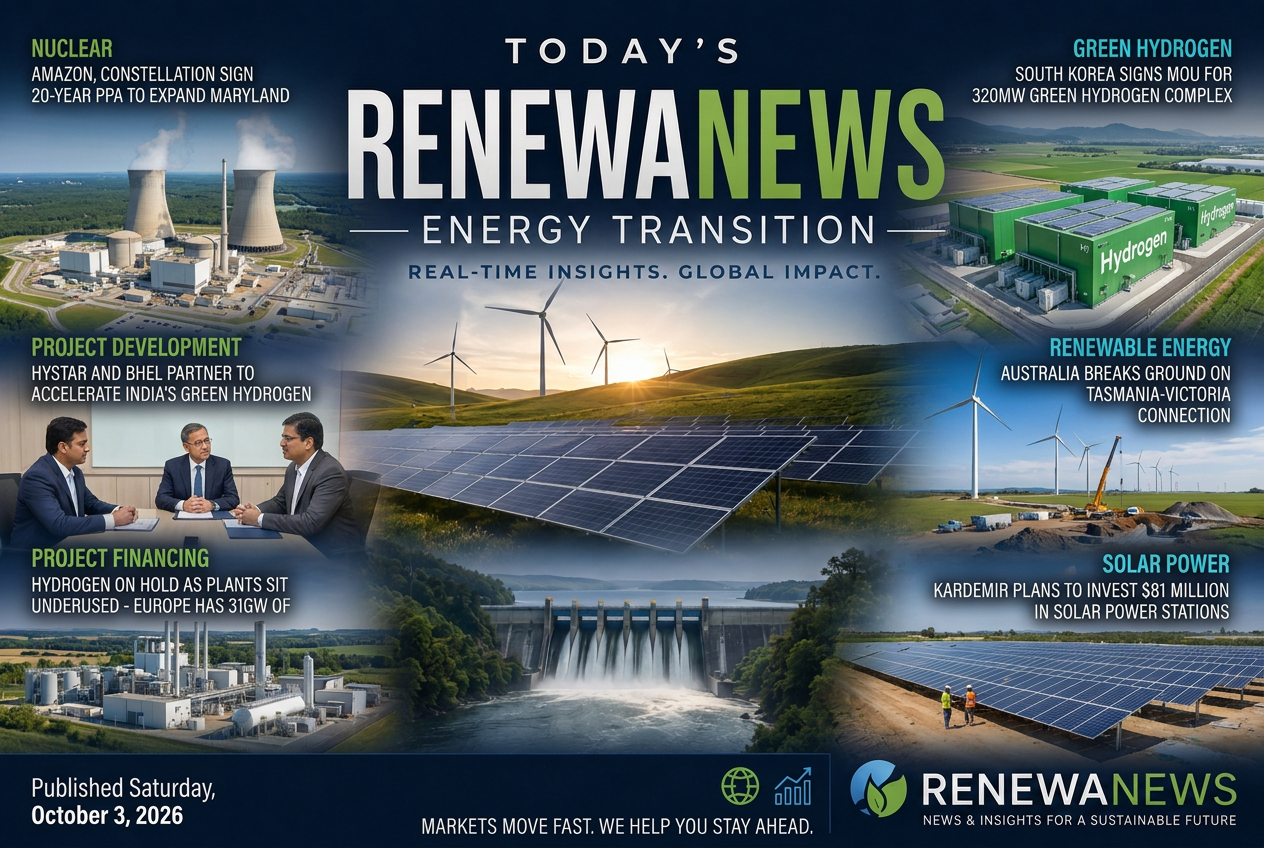
Today's briefing brings you 11 stories across nuclear, green hydrogen, renewable energy and battery storage from the Global Renewables Market. Leading today: Amazon, Constellation sign 20-year PPA to expand Maryland nuclear plant - SightLine | U308.
nuclear
Amazon’s long-term power deal with Constellation points to continued corporate demand for firm low-carbon electricity, and it gives the Maryland nuclear plant a clearer revenue path for an expansion. The agreement also shows how large buyers are using nuclear capacity, not just wind and solar, to support round-the-clock decarbonization.
U308
California is moving to use nuclear policy as part of its clean-energy strategy. The bills suggest a broader effort to keep firm zero-carbon power in the mix as the grid balances reliability with decarbonization goals.
The Center Square
green-hydrogen
South Korea is moving a proposed green hydrogen project forward with an MoU for a 320MW complex. If developed, it would add another large-scale hydrogen asset to Asia’s clean-fuel buildout and support industrial decarbonization, though the agreement still appears to be an early-stage step rather than a final investment decision.
Hydrogen Central
Hystar’s partnership with BHEL points to a push to localize electrolyser manufacturing in India, which can lower supply-chain risk and support faster deployment of green hydrogen projects. The deal also fits the broader effort to build domestic industrial capacity around hydrogen rather than rely on imported equipment.
Hydrogen Central
Europe has a large green hydrogen pipeline on paper, but most of it has not yet cleared the investment hurdle. The gap between announced capacity and final investment decisions suggests slower-than-hoped buildout, with underused plants and weak near-term demand still holding back scale.
Hydrogen Central
The Algiers Declaration adds political weight to the SouthH2 Corridor concept and signals that North African green hydrogen exports to Europe are still moving through the early policy-and-planning phase. For project developers and buyers, the key issue is whether this diplomatic support turns into bankable cross-border infrastructure and offtake commitments.
Trendsnafrica
renewable-energy
Australia has started work on the Tasmania-Victoria interconnector, a transmission project that is meant to move more power between the mainland and Tasmania. For renewables, this matters because stronger interconnection can ease grid bottlenecks and support higher shares of wind and hydro on both sides of the link.
Renewables Now
Kardemir is adding solar power to cut exposure to grid power costs and improve control over its energy supply. The investment also points to continued industrial demand for captive renewable generation as manufacturers look to lower emissions and secure more predictable electricity costs.
GMK Center
This appears to be a funding commitment for renewable energy projects, likely aimed at moving projects in growth markets from plan to execution. Deals like this matter because they lower the financing barrier for new clean-power capacity and support faster deployment where capital is often the main constraint.
Solarbytes
Norway’s sovereign wealth fund is putting major capital into a renewable-energy fund, which signals continued institutional demand for utility-scale clean power assets. For developers and project owners, this kind of backing can lower financing risk and support more projects reaching construction or acquisition.
Renewables Now
battery-storage
Australia is using public support to expand distributed storage alongside rooftop solar, which points to a steady effort to make local grids more flexible and better able to absorb daytime solar output. Hitting 100 community batteries also suggests the model is moving from pilot stage toward wider deployment, with direct implications for reliability and household solar value.
The Cool Down