
RenewaNews Briefing — October 14, 2026
Wednesday, October 14, 2026
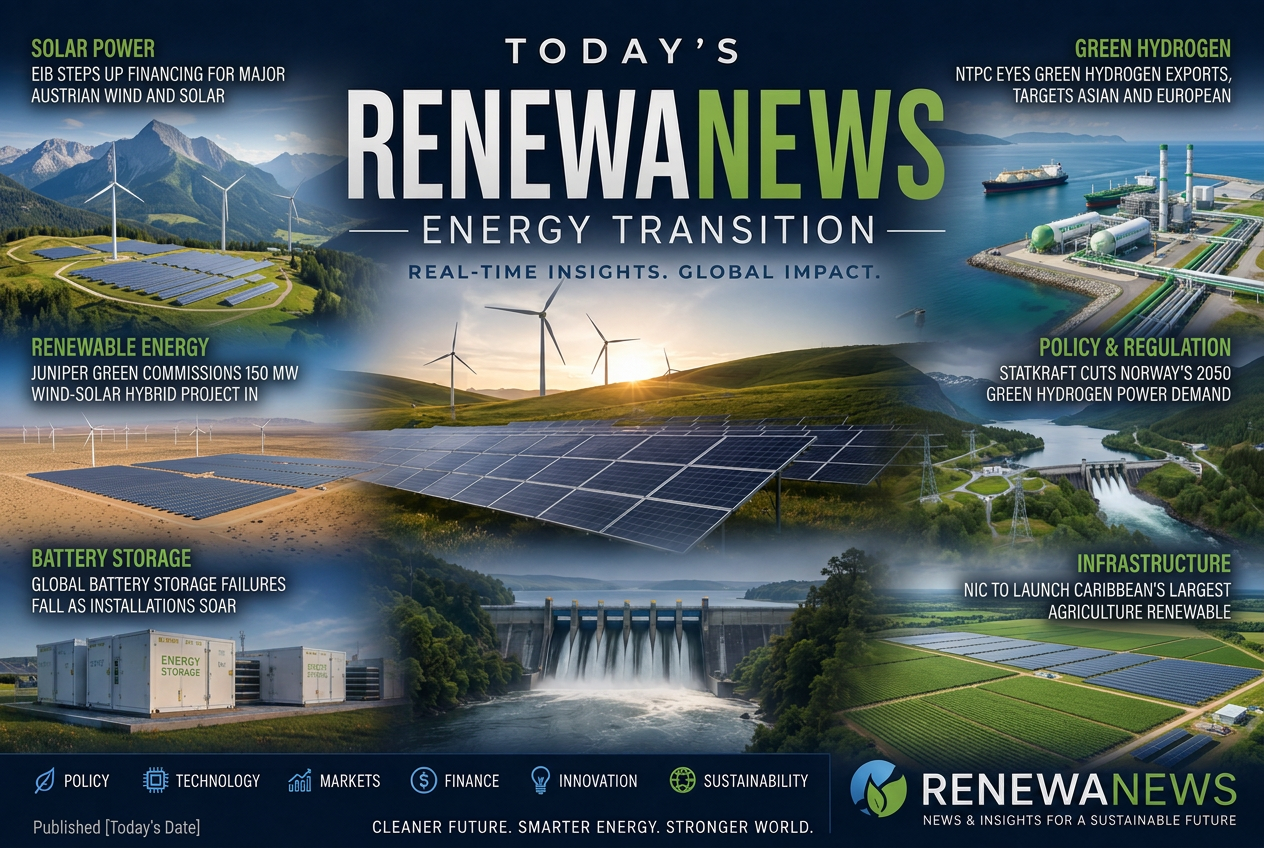
Today's briefing brings you 13 stories across solar power, renewable energy, battery storage and green hydrogen from the Global Renewables Market. Leading today: EIB steps up financing for major Austrian wind and solar project with 20 million euro loan to Burgenland Energie - megaproject.com.
solar
The European Investment Bank is adding low-cost capital to a major Austrian wind and solar buildout. That supports project execution in a market where financing remains central to scaling utility renewable capacity.
megaproject.com
Bangladesh’s Finance Division and PKSF are putting public-backed funding behind solar expansion, which points to continued policy support for distributed and project-scale clean power. Deals like this matter because they can lower financing barriers and help speed deployment in a market that still needs more reliable, affordable generation.
Bangladesh Sangbad Sangstha (BSS)
renewable-energy
Juniper Green has brought a 150 MW wind-solar hybrid project online in Gujarat. The project adds utility-scale renewable generation in India and shows how hybrid assets are being used to combine output and improve project economics.
https://megaproject.com/
The headline points to a large renewable-energy system tied to agriculture, which suggests a practical use of clean power in a real operating sector rather than a general policy announcement. If delivered as described, it would expand local renewable deployment and could lower operating costs and emissions for agricultural users.
IRIE FM
This appears to focus on a legal or policy hurdle affecting tribal clean-energy development in Minnesota. The practical issue is whether tribes can move projects forward without facing extra delay or uncertainty, which matters for local deployment and broader clean-energy access.
KAXE
battery-storage
Battery storage is scaling quickly while failure rates are coming down, which points to a maturing market rather than a more fragile one. For developers, utilities, and investors, that improves bankability and supports wider use of storage for reliability, price stability, and renewable integration.
S&P Global
Vattenfall and Royal Vopak are linking renewable power integration with Dutch energy infrastructure, a sign that grid flexibility and storage-adjacent assets are becoming more important as the Netherlands adds variable wind and solar. The practical question is whether this kind of partnership can make renewable output easier to absorb without raising balancing costs.
Energy Global
Illinois is asking the market what went wrong after its large battery storage procurement failed to attract enough participation. The result points to a mismatch between policy design and project economics, and it matters because storage remains central to keeping the grid flexible as renewables grow.
Energy-Storage.News
Actis is extending its platform in Mexico with a new vehicle aimed at solar-plus-storage development. The move points to continued investor interest in hybrid projects that can improve project economics and help manage grid variability in a market with room for more flexible clean power.
Solarbytes
Captona is backing a distributed clean-power portfolio that pairs community solar with battery storage, which can improve project economics and make output more usable on the grid. The deal points to continued investor interest in storage-added solar assets that can support local decarbonization while smoothing intermittency.
citybiz
GreenYellow and Tilt Energy are moving battery storage into industrial facilities, a sign that onsite flexibility is becoming a practical tool for lowering power costs and improving reliability. Deals like this matter because they can speed storage adoption in commercial and industrial power demand, where backup power and peak management are often as important as decarbonization.
energynews.pro
green-hydrogen
NTPC is signaling that it wants to move beyond domestic green hydrogen use and into export markets. That points to a larger test for Indian hydrogen projects: whether they can reach bankable scale and compete in Asia and Europe on delivered cost, certification, and logistics.
The Hindu
Statkraft is signaling a much smaller long-term power requirement for Norway’s green hydrogen buildout, which suggests slower project scaling and weaker near-term demand pull for electrolyzers and renewable electricity. For developers and investors, the revision is a reminder that hydrogen economics still depend on firm offtake, policy support, and industrial demand that can be slower to materialize than early plans assume.
gasworld