
RenewaNews Briefing — August 19, 2026
Wednesday, August 19, 2026
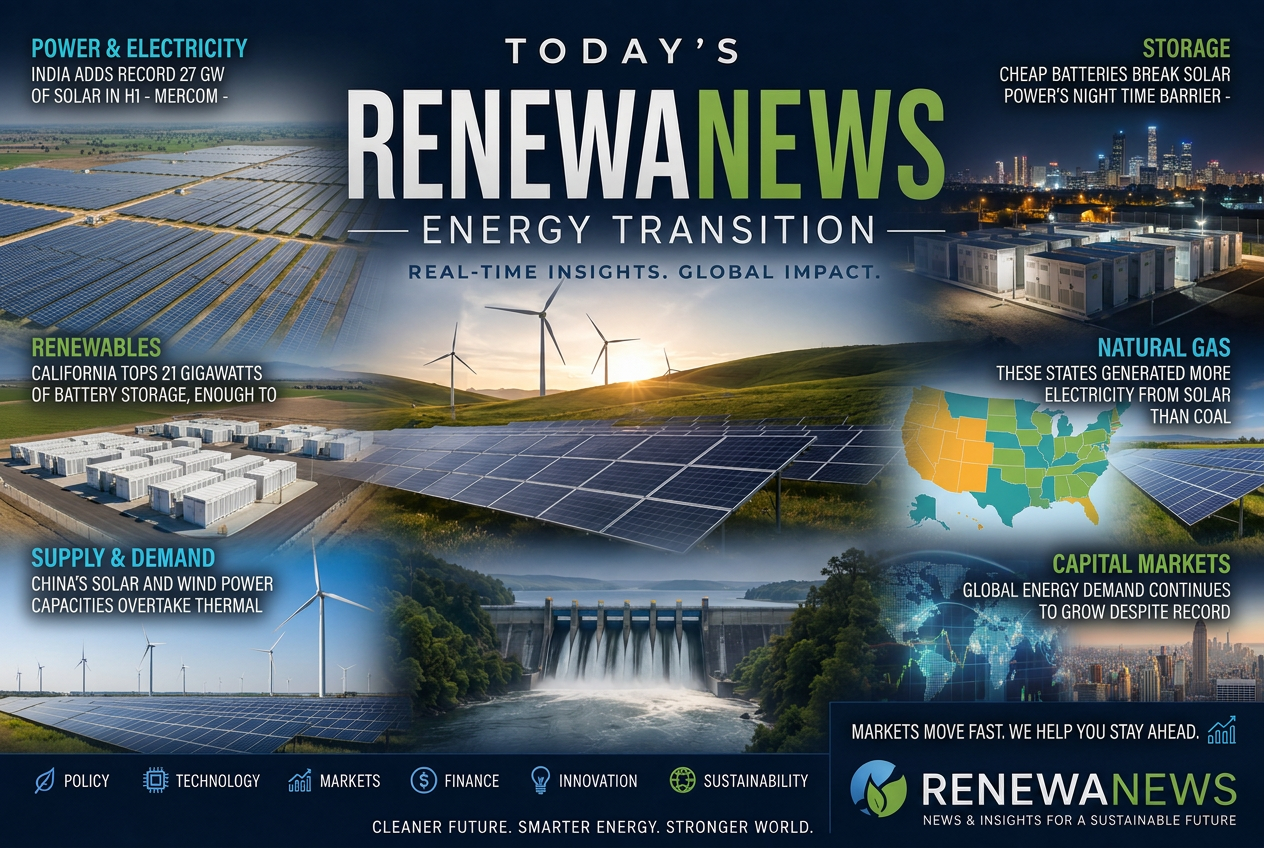
Today's briefing brings you 25 stories across policy, midstream, markets and technology from the Global Renewables Market. Leading today: India adds record 27 GW of solar in H1 - Mercom - renewablesnow.com.
Policy
Record solar additions in India point to continued capital shifting toward power assets that can absorb growth in electricity demand and compete with imported fuels. For oil and gas executives, it signals stronger long-term pressure on regional power-market share and faster clean-energy buildout from a major demand center.
renewablesnow.com
Transmission bottlenecks can slow the pace at which renewable projects reach the grid, which can shift capital toward regions with faster interconnection and lower execution risk. For energy executives, this is a signal that policy support alone is not enough; grid buildout and permitting will increasingly determine where renewable capacity can be added profitably.
thehindu.com
Hungary’s potential wind buildout signals where capital and permitting may shift in Central Europe, which can affect project pipelines for turbines, grid work, and power buyers. For executives, it points to a stronger renewables push that could reshape regional competition for generation investment and balancing assets.
Daily News Hungary
Vietnam’s push to expand wind power signals where future power-sector capital will be directed, with implications for developers, turbine and grid suppliers, and the pace at which gas and coal can be displaced. For executives, it points to a policy-backed shift in the region’s generation mix that could reshape electricity demand and competitive positioning across the power market.
vietnamnews.vn
This signals that offshore wind remains a political and permitting issue in Massachusetts, which matters because it can affect power-sector buildout and the pace at which new generation reaches the regional market. For executives, the key takeaway is that policy support for renewables may be uneven, leaving room for gas-fired and other dispatchable supply to remain important in the near term.
MassLive.com
Midstream
California’s buildout of grid-scale batteries signals stronger demand for dispatchable power assets and can support more renewable integration without immediate gas-fired backup. For executives, it points to a market where storage is taking a larger role in balancing peak load and where capital is continuing to shift toward grid flexibility.
The Cool Down
Cheaper battery storage extends the economic role of solar beyond daylight hours, which can shift capital toward paired renewable-plus-storage projects and intensify competition for flexible power supply. For executives, it signals a faster path for renewables to capture firm capacity value and pressure gas-fired peakers in balancing markets.
Energi Media
Finland’s first industrial-scale liquefied biogas facility signals that renewable gas is moving from pilot projects into commercial infrastructure. For an executive, that points to emerging competition for low-carbon molecules in transport and industrial fuel markets, with implications for capital allocation in bioenergy and midstream logistics.
Renewables Now
This signals that battery storage is becoming an execution tool for balancing intermittent renewable output, which can shift where utilities and power buyers allocate capital. For oil and gas executives, it underscores rising competition from firmed clean power in California and the broader pressure on gas-fired generation and grid peaking capacity.
Lost Coast Outpost
Lower battery storage costs improve the economics of grid-scale storage, which can shift utility and developer capital toward more projects that firm renewables and manage power-price volatility. For an oil and gas executive, that signals faster competition from electrification and storage in markets where gas-fired generation and peaking assets still set marginal power supply.
qz.com
Grid and storage constraints are becoming a gating factor for renewable buildout, which matters because it shifts value toward developers and suppliers that can pair generation with transmission access and flexible storage. For executives, this signals that capital will increasingly favor projects with better grid integration rather than capacity additions alone.
pv magazine India
A large wind, solar, and storage buildout in Oregon signals where capital is moving in the power market and how developers are pairing generation with storage to secure grid interconnection and offtake. For oil and gas executives, it is a reminder that renewable buildout can tighten competition for land, transmission, and utility capital in the Pacific Northwest.
The Business Journals
Markets
China's shift toward more solar and wind capacity signals that incremental power demand is being met with renewables rather than thermal generation, which can ease coal and gas burn growth. For executives, that points to a tougher long-term outlook for imported fuel demand and a stronger position for firms tied to renewable supply chains and grid investment.
news.sbs.co.kr
Solar surpassing coal or gas in state power generation signals a further shift in utility load growth and generation mix toward renewables. For executives, that affects capital allocation, gas-fired plant utilization, and the competitive outlook for fossil generation in US power markets.
bgr.com
Rising global energy demand alongside rapid renewable buildout signals that fossil fuels are likely to remain necessary in the mix, supporting continued upstream, LNG, and infrastructure spending. For executives, the key takeaway is that capital allocation still has to balance decarbonization investment with supply growth to avoid tightening the market.
kpmg.com
Higher summer load and weaker wind output point to tighter power balance in Texas, which can lift prices and increase the value of flexible generation and demand-side resources. For executives, it also underscores how weather-driven volatility in ERCOT can affect operating costs, hedging, and investment decisions tied to load growth and grid reliability.
Hart Energy
Africa’s power shortfall matters because it can constrain industrial growth and slow the buildout of new energy demand, even where renewable resource potential is strong. For executives, it signals that capital will keep favoring projects tied to grid access, bankable offtake, and infrastructure rather than resource availability alone.
Business Daily
This signals a regional policy push to attract clean energy capital, which can steer project pipelines, partnership formation, and financing priorities across Southeast Asia. For executives, it matters because it can strengthen renewables and power-market competition while shaping where investment flows in the ASEAN energy transition.
ASEAN Centre for Energy (ACE)
A higher renewables share in Colbun’s Chile generation mix points to stronger low-carbon exposure and may support cleaner power supply for customers, which can influence power pricing and contracting strategy in the region. For executives, it signals continued capital and operational emphasis on renewable assets rather than thermal generation.
Renewables Now
A high renewable share in Latin America and the Caribbean signals continued pressure on thermal generation and a stronger competitive backdrop for gas and LNG suppliers in the region. For executives, it points to where power investment and offtake growth may be shifting as grid mix changes.
Renewables Now
Technology
This signals that Fortescue is still advancing decarbonized ironmaking, which matters because industrial buyers and resource peers are watching whether low-emissions metal can move from pilot scale toward commercial capital deployment. For executives, it is a read on future demand for renewable power, processing technology, and the competitiveness of green steel supply chains.
renewablesnow.com
This looks like a workforce and project-development signal rather than a direct market move. For executives, it suggests local capacity-building around renewables that can improve labor availability and vendor readiness as low-carbon projects compete for capital and execution resources.
Houghton Lake Resorter
This signals continued investor interest in small-scale distributed energy systems that turn agricultural waste into usable power, which can compete with grid electricity and on-site fuel spending. For an executive, it is a reminder that decarbonization value is spreading into rural and farm-adjacent markets where local resource capture can lower operating costs.
EU-Startups
Regulatory
PJM transmission and interconnection decisions affect how quickly new power supply can reach the grid, which matters for gas demand from power generation and for the competitiveness of new generation projects. Delays or approvals also signal where capital is likely to flow in the Northeast power market.
Environment America
Boston’s zoning shift suggests local permitting is becoming more supportive of distributed clean energy assets, which can accelerate rooftop, battery, and other small-scale infrastructure deployment in dense markets. For executives, it signals where capital can move faster in urban load centers and where policy is shaping the competitive field for behind-the-meter power.
Smart Cities World