
RenewaNews Briefing — August 20, 2026
Thursday, August 20, 2026
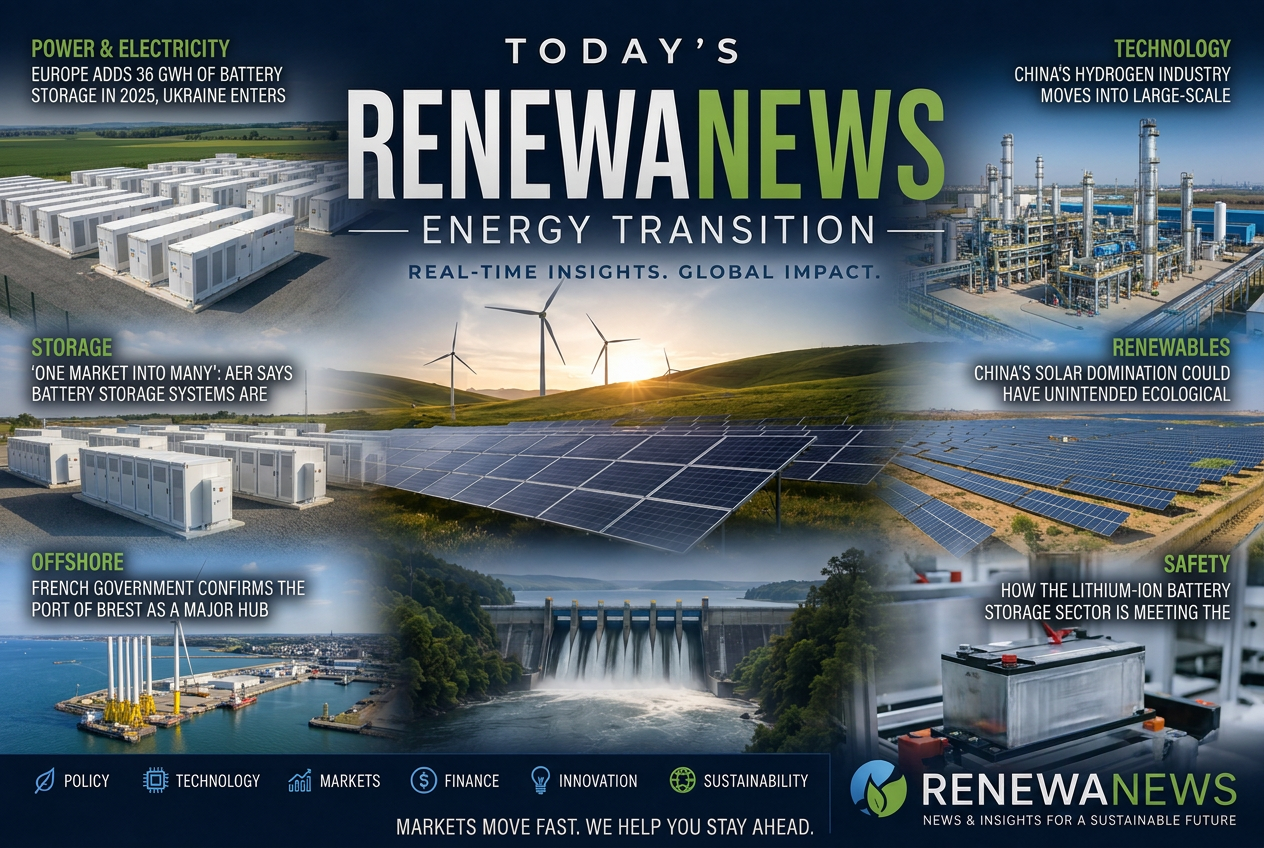
Today's briefing brings you 20 stories across midstream, technology, regulatory and markets from the Global Renewables Market. Leading today: Europe adds 36 GWh of battery storage in 2025, Ukraine enters top five markets - pv magazine Global.
Midstream
Europe’s battery buildout points to stronger grid-flexibility spending, which can reshape power market economics and support more renewables integration. Ukraine’s presence among the largest markets signals that storage demand is broadening beyond the usual core countries, which matters for capital allocation and competitive positioning across the region.
pv magazine Global
Battery storage is changing how power is priced and dispatched in Australia’s grid, which matters for companies with exposure to flexible generation, trading, and grid services. It signals that capital is shifting toward assets that can capture volatility and compete with peaking supply rather than baseload-only projects.
Energy-Storage.News
Improved fire-risk controls in lithium-ion storage can reduce permitting friction and lower the operational hurdle for utility-scale batteries, which matters for investors and power developers backing grid flexibility projects. It also signals that safety standards are becoming a competitive factor in where storage assets get built and how quickly they reach commercial operation.
Innovation News Network
Utility-scale renewable and storage buildout signals continued capital reallocation toward resources that can support load growth and grid reliability. For an oil and gas executive, it underscores how power demand and decarbonization commitments are reshaping utility procurement and long-term generation competition.
renewableenergymagazine.com
Romania signaling support for battery storage alongside solar points to a policy shift toward firming intermittent generation, which matters for developers deciding where to deploy capital in the region. For executives, it suggests storage is becoming a required companion asset in power markets with growing renewables penetration, changing the economics of future project pipelines.
Balkan Green Energy News
The audit signals that New York’s transit decarbonization plans are slipping, which can slow near-term demand for electric buses, charging infrastructure, and related capital spending. For executives, it is a reminder that policy-driven fleet turnover can be delayed by procurement and implementation bottlenecks, affecting suppliers and infrastructure developers tied to public-sector electrification.
Gothamist
Technology
China’s move toward commercial-scale hydrogen suggests policy support is shifting from pilots to infrastructure buildout, which can redirect capital toward electrolyzers, storage, and transport networks. For oil and gas executives, it signals a potential long-term competitive pressure on gas demand and a faster emerging low-carbon rival in industrial energy markets.
People's Daily Online
Europe’s push to source green hydrogen from MENA and Africa signals that future clean-fuel supply chains will be built around imported molecules rather than domestic production alone. For oil and gas executives, it points to new capital competition for export infrastructure, long-term offtake relationships, and a shift in where low-carbon project value may accrue.
Devdiscourse
The piece suggests the Middle East’s solar buildout is shifting from simple generation additions toward grid-flexibility investments, which can change where capital is deployed in the power value chain. For executives, that points to more spending on storage, digital controls, and grid integration rather than standalone solar capacity.
SolarQuarter
The milestone signals continued buildout of grid infrastructure needed to move offshore wind power from coastal generation into load centers, which affects where utilities and developers direct capital. For executives, it is a reminder that transmission capability can be a bottleneck for renewable integration and a source of competitive advantage for firms tied to grid equipment and project development.
China Daily
This signals continued investor interest in new U.S. power and energy infrastructure platforms, which can redirect capital toward distributed generation and related grid services. For executives, it is another sign that competition is broadening beyond traditional utility models into decentralized energy assets that can affect load growth, project financing, and customer acquisition.
Renewables Now
Regulatory
China’s solar buildout is a reminder that renewable expansion can create supply-chain and environmental scrutiny that affects project permitting, procurement, and social license. For executives, it signals that scaling clean power now carries reputational and regulatory risk alongside the push to secure generation capacity.
Scientific American
Indonesia’s industrial policy matters because it points to how the country will balance decarbonization goals against continued dependence on coal-heavy power and emissions-intensive manufacturing. For energy executives, that can affect where capital is allocated in Southeast Asia and how attractive Indonesia is for low-carbon industrial projects versus conventional resource investment.
fulcrum.sg
DEWA’s emphasis on environmental stewardship signals that clean-energy buildout in Dubai is being tied to permitting, execution standards, and long-term project bankability rather than just capacity additions. For industry executives, it suggests that sustainability metrics are becoming part of the competitive bar for winning utility-scale work in the Middle East.
SolarQuarter
A demo biocoal plant points to industrial users and investors testing lower-carbon feedstock options that could change fuel sourcing for energy-intensive manufacturing. For executives, it signals early demand for biomass-based alternatives and a possible opening for suppliers tied to decarbonization projects in South Asia.
WWD
Markets
This signals where European offshore wind manufacturing capacity is being concentrated, which matters for suppliers, marine contractors, and developers deciding where to place capital and fabrication work. It also reinforces the competitive importance of port infrastructure in the buildout of floating wind projects and the broader renewable supply chain.
renewableenergymagazine.com
Policy
Maryland's solar procurement signals continued policy support for utility-scale renewables and could influence how power buyers allocate capital toward lower-carbon supply. For executives with utility, land, or grid-exposed assets, it points to stronger demand for solar projects and related interconnection and transmission work in the region.
governor.maryland.gov
State incentives for battery storage can accelerate distributed power investment and shift more capital toward grid-balancing assets rather than purely generation-focused projects. For oil and gas executives, it signals continued policy support for renewables that can affect power demand, site electrification planning, and competitive positioning in local energy markets.
The Timberjay
School rooftop solar potential signals another distributed generation channel that can chip away at retail power demand and reshape how utilities plan load growth. For oil and gas executives, it is a reminder that electrification and local renewables are increasingly part of the competitive energy mix in key U.S. markets.
WRAL
The partnership suggests utilities and local institutions are using pilot projects to build support for renewable development, which can influence how quickly capital shifts toward cleaner generation in Illinois. For executives, it signals a policy and demand environment where power buyers and developers may find more room for renewable projects and related grid investment.
25 News Now