
ShaleMarkets Briefing — August 17, 2026
Monday, August 17, 2026
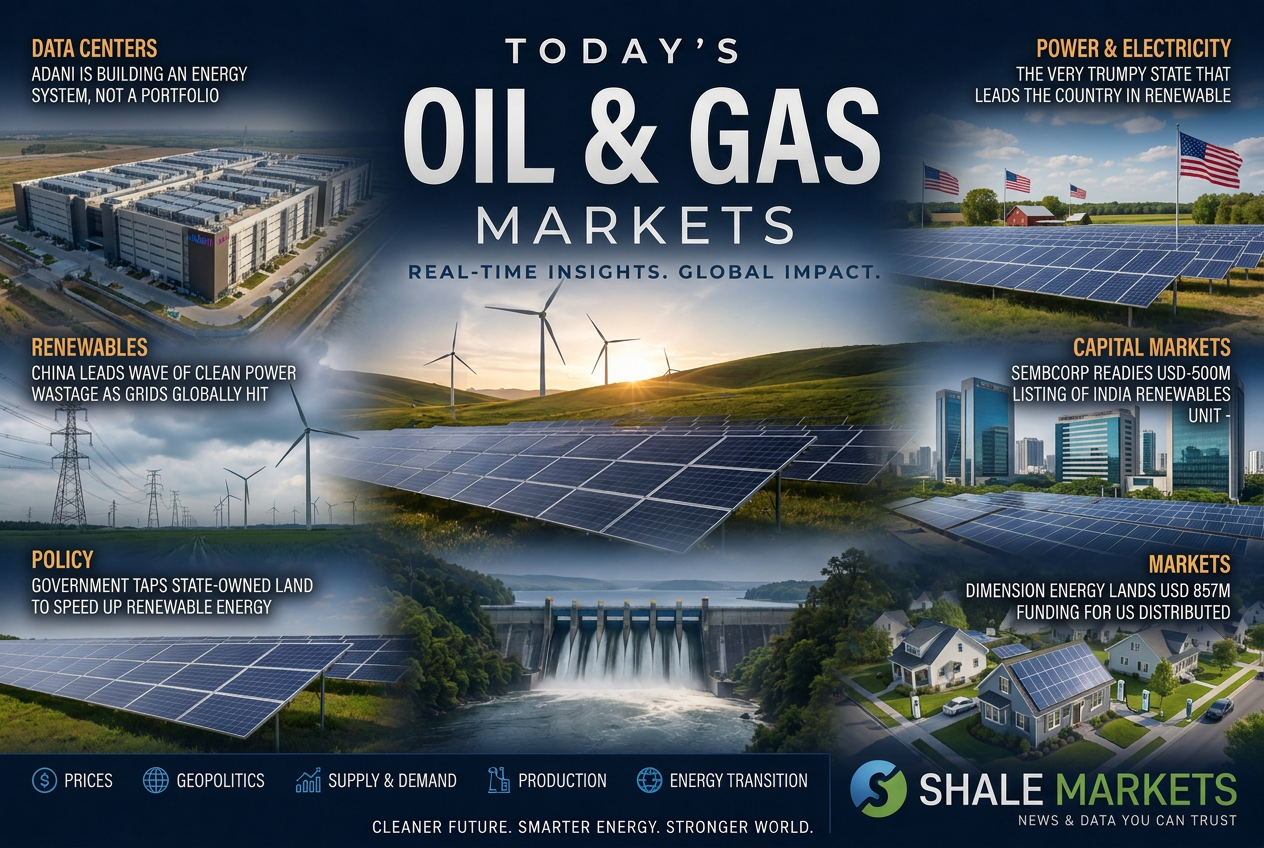
Today's briefing brings you 41 stories across technology, policy, regulatory and markets from across North American oil and gas. Leading today: Adani Is Building an Energy System, Not a Portfolio.
Technology
A Vizag transmission handover, an Odisha nuclear pitch, and a copper venture reveal Adani's real strategy: capturing the capital-intensive middle of India's energy buildout under common promoter control.
From Our Desk
Fast-tracking data centers tied to wind-backed power shows how states are competing on grid access and clean electricity to attract digital infrastructure. For energy executives, it signals rising load growth that can reshape power procurement, renewable buildout, and local gas-fired backup needs.
Google Search
This points to more collaboration between a large utility and a leading research institution, which can steer capital toward early-stage clean energy technologies before they are ready for commercial deployment. For executives, the signal is that competitive advantage may increasingly hinge on access to R&D partnerships and the ability to translate innovation into scalable power and decarbonization assets.
Google Search
Policy
Texas remains a critical test case for how renewable buildout can reshape capital allocation in a hydrocarbon-heavy state. For an executive, it signals that power demand, grid constraints, and project economics are increasingly steering investment toward solar and wind alongside traditional oil and gas activity.
Google Search
This signals a push to reduce permitting and land-access bottlenecks for new power projects, which can shift capital toward utility-scale renewables and related grid buildout. For oil and gas executives, it matters because faster renewables deployment can intensify competition for investment, land, and policy support in the power market.
Google Search
The auction signals additional policy-backed demand for power projects in Southeast Asia, which can influence how developers and financiers allocate capital across utility-scale renewables and waste-to-energy assets. For operators in the region, it is a read on how quickly governments are broadening the competitive mix for new generation capacity.
Google Search
This signals that Turkey and Saudi Arabia are using renewable projects to deepen economic ties and diversify power supply, which can shift capital toward utility-scale solar and wind rather than hydrocarbons in parts of the region. For executives, it is a marker of where state-backed energy investment and competitive positioning are moving in the Middle East.
Google Search
Romania’s energy mix shifting toward renewables signals a continued squeeze on conventional generation and a stronger case for capital into low-carbon assets and grid flexibility. For executives with exposure to power demand or regional infrastructure, it points to a market where competitive positioning will depend more on renewable integration and balancing services than on legacy fuel supply.
Google Search
Chinese-backed solar and other new energy buildout in Jordan points to where capital and industrial capacity are flowing in the region. For executives, it signals growing competition in Middle East power development and a stronger pull toward renewables in markets that still matter for upstream and LNG strategy.
Google Search
The cancellation signals that industrial hydrogen remains vulnerable to weak project economics and customer commitment, even in a policy-rich European market. For refiners and suppliers, it suggests capital may continue to favor lower-risk decarbonization options rather than large new hydrogen builds.
Google Search
China’s power-system imbalance still matters to global energy executives because it shows how fast renewable buildout can outpace grid absorption, creating pressure to curtail output and rework capital deployment. For oil and gas firms, that kind of congestion can influence long-term electricity competition, industrial power costs, and the pace of electrification-driven demand growth.
Google Search
This signals ongoing policy-backed demand for distributed solar buildout in India, which matters for equipment vendors, project developers, and financiers watching where capital is still flowing in renewables. For power-market executives, it suggests rural and agricultural electrification programs remain a real deployment channel even as broader energy investment stays competitive.
Google Search
The piece appears to frame the Indo-Pacific as a strategic center for clean-energy buildout, which matters because it points to where future capital, supply chains, and policy influence may concentrate. For executives, that signals competitive positioning in renewables, grid investment, and regional partnerships rather than near-term oil and gas fundamentals.
Google Search
This signals public-sector demand for rooftop solar and related installation work, which can support distributed-generation buildout and create a reference point for broader commercial adoption. For an executive, it points to policy-backed activity in the renewables supply chain rather than conventional power or fuel demand.
Google Search
Regulatory
Grid congestion and curtailment in China signal that renewable buildout is colliding with transmission limits, which can slow new project returns and shift capital toward grids, storage, and flexible generation. For executives, this is a reminder that clean-power growth is now constrained as much by infrastructure and market design as by equipment costs.
Google Search
ReNew's sustainability reporting matters because it signals how aggressively the company is tying capital deployment to decarbonization and operational discipline. For executives, that can affect how investors assess renewable growth, financing access, and competitive positioning in India’s power market.
Google Search
Wildfire smoke and haze can cut solar output and raise the value of more reliable generation and grid flexibility, which matters for how utilities and power investors allocate capital. For oil and gas executives, it is another sign that climate-linked disruption is reshaping the competitive balance in power markets and may slow the pace of renewable penetration in affected regions.
Google Search
This signals continuing utility-scale renewable procurement in India, which matters to executives tracking where large power offtake and capital are flowing. Winning a share of a firm-and-dispatchable tender can improve a developer’s competitive position and support financing for projects built around round-the-clock supply requirements.
Google Search
Azerbaijan setting aside sea area for offshore wind signals that the government is formalizing space for utility-scale power development, which can reshape how capital is allocated between hydrocarbons and low-carbon projects. For operators and investors in the Caspian, it also points to future competition for offshore infrastructure, grid access, and regulatory priority.
Google Search
This signals that renewable operators are improving operating performance while lowering emissions, which matters for capital allocation toward lower-carbon assets and for how quickly clean power can compete on efficiency. For an executive, it suggests the sector is moving from pure growth to measurable productivity and carbon-intensity gains.
Google Search
This signals a regulatory opening for distributed power that can shift some electricity demand generation away from the grid and into customer-sited systems. For utilities and energy investors, it highlights growing competition for retail power sales and a potential uptick in small-scale renewable adoption.
Google Search
This signals local policy support for distributed clean power, which can affect how municipalities in the Philippines prioritize future generation and grid investments. For an executive, it is a reminder that renewable energy is becoming part of regional development strategy, not just a standalone power-sector issue.
Google Search
Markets
A potential listing of the India renewables unit would give Sembcorp a direct valuation marker and could free up capital for new investments or debt reduction. For industry executives, it signals continuing appetite for listed renewable assets in India and may sharpen competition for capital across clean-power portfolios.
Google Search
The funding shows capital is still available for distributed solar platforms, which can tighten competition for power supply deals and tax-equity-driven project financing across the U.S. power market. For oil and gas executives, it is a signal that investor appetite is broadening toward lower-carbon infrastructure that competes for the same deployment capital and customer relationships.
Google Search
A sharp increase in wind output signals that Azerbaijan is adding more non-hydrocarbon supply to its power mix, which can modestly ease domestic gas burn and free more molecules for export. For an executive, it points to a slowly diversifying energy system that could affect regional gas balance and long-term capital allocation.
Google Search
This signals continued regional policy support for hydrogen buildout in Asia, which can accelerate project screening and channel capital toward companies tied to production, storage, and supply-chain infrastructure. For executives, it is a reminder that public support remains a key competitive lever in lower-carbon molecules markets where bankability is still emerging.
Google Search
Kazakhstan adding domestic wind-equipment assembly signals a push to localize clean-power supply chains and reduce reliance on imported components. For executives, it points to incremental renewable-buildout support and a growing competitive focus on industrial capacity in Central Asia.
Google Search
This signals that capital is still flowing into hydrogen as a decarbonization play, which can draw investment attention away from more established oil and gas projects. For executives, it also suggests growing competition for project finance in Africa-linked energy transition assets and a potential long-term demand challenge for conventional fuels if such projects scale.
Google Search
The refinancing shows that large-scale renewable assets can still access substantial debt capital, which matters for how aggressively utilities and infrastructure investors can keep funding power projects. For oil and gas executives, it is a signal that capital is continuing to move toward lower-carbon electricity, tightening the competition for project finance and long-dated investment capital.
Google Search
The project signals continued capital flowing into utility-scale renewables in Egypt, which can affect regional power investment and the pace of gas displacement in the local energy mix. For executives, it is a reminder that low-carbon buildout is still competing directly for infrastructure capital and long-term supply contracts in the Middle East.
Google Search
Edify Energy’s growing presence in solar and battery storage signals where capital is still finding growth outside traditional hydrocarbons. For oil and gas executives, it underscores continued competition from renewables for grid investment and long-duration power demand, especially in markets with strong policy support.
Google Search
The piece matters because it points to how variable renewable output can affect grid stability during peak demand, which informs utility dispatch planning and near-term power-market risk. For executives, it is a signal to watch how weather-driven generation swings may influence investment in firm capacity, storage, and grid flexibility.
Google Search
The move signals Venus Pipes is lowering operating costs and reducing exposure to power-price volatility, which can support margins and competitiveness if energy prices stay elevated. For industrial operators, on-site renewables also point to capital being directed toward efficiency rather than core capacity growth.
Google Search
This financing shows development capital is still available for utility-scale power projects in Europe, which can pull investment toward hybrid generation rather than upstream oil and gas. For executives, it signals that competitive funding conditions are helping renewable developers advance projects and shape regional power supply expectations.
Google Search
The commissioning of new solar capacity in Uganda signals continued buildout of local power infrastructure, which can ease electricity constraints and support industrial growth in the region. For executives, it indicates where renewable capital is being deployed and where future power availability may improve for operations and investment.
Google Search
Midstream
Battery storage deployments in Chile signal continued capital flow into grid-balancing assets that support renewable power buildout and help reduce curtailment risk. For executives, this points to growing demand for storage as a competitive layer in Latin American power markets rather than a standalone niche project.
Google Search
This signals continued capital rotation into grid-scale storage in Europe, where investors are treating batteries as a core asset class rather than a niche add-on. For executives, it points to stronger competition for operating storage portfolios and growing value in flexibility assets that can support renewables and power price volatility.
Google Search
This signals continued European capital flowing into utility-scale solar paired with storage, which can tighten competition for grid connections and development sites. For executives, it is a reminder that integrated power projects are attracting financing because they can deliver dispatchable renewable output rather than stand-alone solar capacity.
Google Search
Delays in Europe’s hydrogen buildout signal that low-carbon fuel demand and supporting infrastructure will arrive later than planned, which can slow capital deployment across electrolyzers, pipelines, and storage. For incumbents, the setback favors nearer-term gas and power assets while widening the competitive gap for projects that depended on a faster hydrogen network.
Google Search
This signals ongoing commercialization of inverterless battery storage, which can lower system complexity and reshape procurement decisions for grid-scale storage projects. For executives, it points to a technology differentiation race in the Australian power market rather than a simple capacity addition story.
Google Search
Drilling
Permitting for a uranium work program reduces execution risk and signals that capital can now move from planning into field activity. For an executive, this is relevant because it can tighten the supply outlook for domestic nuclear fuel projects and improve the competitive position of junior uranium developers with permitted assets.
Google Search