Adani Is Building an Energy System, Not a Portfolio
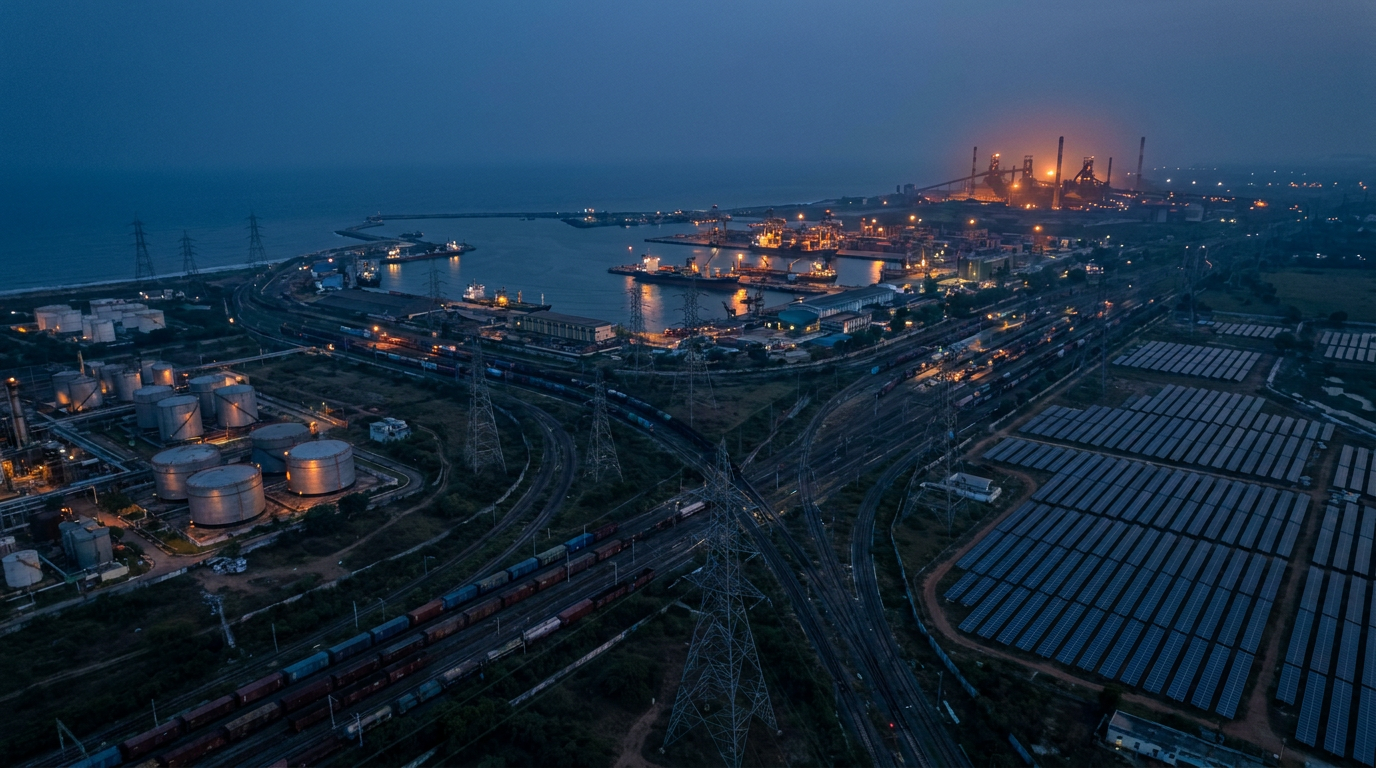
Original illustration created for RenewaNews.

Adani Is Building an Energy System, Not a Portfolio
On August 14, 2026, REC Power Development and Consultancy Limited formally handed over the Vizag Power Transmission Limited special purpose vehicle to Adani Energy Solutions. The line is rated to carry roughly 4.5 GW of power into green hydrogen and green ammonia projects proposed for the Vizag region of Andhra Pradesh, India CSR reported on August 15, 2026. Adani Energy Solutions won the mandate through competitive bidding on a project valued at approximately ₹8,500 crore, the Economic Times reported on August 14, 2026.
The day before the handover was announced, on August 13, 2026, Adani Ports and SEZ CEO Karan Adani met Odisha Chief Minister Mohan Charan Majhi to push a different piece of the same buildout: a "clean energy triad" pairing 6,000 MW of nuclear capacity with pumped storage and solar, The Financial Express reported on August 16, 2026. Only the nuclear component carries a stated size; the pumped storage and solar legs do not. Bundled into the same pitch was an ₹80,000 crore integrated coal gasification and coal-to-chemicals plant at Bedabahal in Sundargarh district.
Nuclear baseload and coal-to-chemicals sit awkwardly next to Adani Green Energy, which runs 19.3 GW of operational renewable capacity, per its own FY26 annual report. Read against the Vizag handover, the pattern is not a scattered set of bets but one design: control the capital-intensive middle of India's energy build — transmission, fuel, and offtake — rather than just the generation asset at the end of it.
The Odisha proposal grows from 5,600 MW to a fixed 6,000
Business Standard reported on August 3, 2026 that an Adani delegation led by Subrat Tripathy, President of Business Development at Adani Ports and SEZ, presented Odisha's Energy Minister Kanak Vardhan Singh Deo with a proposal for two plants totaling 5,600 MW to 6,000 MW, at an estimated ₹1.5 trillion ($18 billion). If it clears approval, Business Standard noted, it would be the first major private investment in India's nuclear sector.
By August 16 the capacity figure had firmed to 6,000 MW across two 3,000 MW plants, and The Financial Express placed the project inside a new legal opening: the SHANTI Act, 2025, which creates a framework for private participation as India works toward a stated goal of 100 GW of nuclear capacity. Whalesbook's August 14, 2026 report adds the industrial layer underneath the power plan — bauxite mining, an alumina refinery at Rayagada, an aluminium smelter at Cuttack — feeding off the Sundargarh coal-to-chemicals facility and the group's existing Dhamra Port.
Put those pieces on a map and the mechanism is visible. A conventional independent power producer takes construction risk on a plant and then sells the output into a market or a long-term power purchase agreement, leaving fuel-cost risk and demand risk to someone else's balance sheet. Adani's Odisha structure coordinates the mine, the smelter, the port, and the power plant across group companies under common promoter control: the aluminium business becomes the buyer of last resort for the power business, and the group's own logistics absorb input-cost swings that would otherwise sit with an outside fuel supplier.
What the grid actually needs
The Vizag transmission win answers a narrower question than the Odisha plan: not whether India can build generation, but whether it can move power to where industrial demand is forming. Speaking at the Mint Sustainability Summit on August 7, 2026, Deepak Thakur, CEO of Hinduja Renewables, described the shift underway across the sector: projects "cannot be standalone solar and wind anymore; we have to talk about integrated portfolios" combining generation, storage, and transmission. Mint's report from that summit framed the next phase of India's transition as one measured by firm-power delivery rather than nameplate capacity.
Startup Fortune reported on August 13, 2026 that AI data centers are projected to add 26.3 GW of load in India by 2031-32, and that hyperscalers including Google and Microsoft are committing capital to hubs such as Vizag. Adani's Vizag mandate is one instance of a developer capturing the firm-power layer directly, rather than leaving transmission to state utilities and waiting for a generation queue to clear.
A smaller piece: copper and cable
Adani Enterprises has also moved into wire and cable manufacturing through its Kutch Copper subsidiary, the International Wire & Cable Trade Association reported on June 19, 2025. The stated logic is vertical: the group's existing footprint in energy, ports, and transportation gives it a built-in customer base for the copper it now produces itself. It is a smaller move than the nuclear or transmission plans, but it follows the same pattern of keeping a margin inside the group rather than ceding it to a supplier.
Centralizing capital allocation across companies
Adani Green Energy's annual report, published May 31, 2026, states the ambition directly. Chairman Gautam Adani calls the group "the world's most integrated infrastructure platform," spanning energy, transport, logistics, and industrial manufacturing. Ashish Khanna, CEO of Adani Green Energy, is quoted describing a shift toward "complete energy supply chain solutions" as the transition reshapes how energy systems are "financed, built and operated."
The Economic Times reported on May 1, 2026 that Gautam Adani had restructured the group into a flatter, three-layer organization to speed decisions and manage what the report called the "construction risk" of running mega-projects in nuclear and green hydrogen at the same time. Centralizing capital allocation is what lets group companies under common promoter control carry a nuclear plant, a coal-to-chemicals facility, an aluminium smelter, and a hydrogen transmission line without each project competing for financing on its own terms.
What it means for a bidder
A standalone renewables developer competing for the next Indian solar or storage tender is not really bidding against Adani's solar business alone; it is bidding against a group that can price transmission access, fuel logistics, and captive offtake into the same project. RECPDCL's decision to hand the Vizag SPV to Adani Energy Solutions, rather than building it out itself, put a piece of that regional grid backbone directly under one private group's control.
Whether Odisha's nuclear plants clear regulatory approval remains unresolved, and the reporting to date does not establish how the SHANTI Act's private-participation framework will hold up against a state-level buildout of this size — a genuine open question sitting alongside a proposal that, at ₹1.5 trillion, is already the largest private nuclear pitch India has seen. What is established is the shape of the bet: fuel, metal, wire, and transmission, assembled under common promoter control before rivals decide which single layer of that stack is worth fighting over.
Sources
This article was reported from the following sources.
Adani's Odisha power push: 6,000 MW nuclear plan, pumped storage plants and solar to build a reliable clean energy base — The Financial Express, 2026-08-16
Adani Energy Wins ₹8,386 Crore Vizag Green Hydrogen Transmission Project — India CSR, 2026-08-15
Adani Energy Solutions wins Vizag green hydrogen transmission project — The Economic Times, 2026-08-14
Storage, transmission key for next phase of India's energy transition: Experts — Mint, 2026-08-07
Adani plans ₹1.5 trillion investment in Odisha nuclear power projects — Business Standard, 2026-08-03
India's Power Grid May Not Be Ready to Fuel the AI Data Center Boom — Startup Fortune, 2026-08-13
Adani Green Energy Limited | Integrated Annual Report 2025-26 — Adani Group, 2026-05-31
Adani Group Proposes Nuclear Plants, ₹80,000 Cr Odisha Project — Whalesbook, 2026-08-14
Adani Group unveils sweeping overhaul to accelerate decisions and power next growth phase — The Economic Times, 2026-05-01
Adani Group's Strategic Entry into the Wire & Cable Industry — International Wire & Cable Trade Association (IWMA), 2025-06-19