
RenewaNews Briefing — August 21, 2026
Friday, August 21, 2026
Today's briefing brings you 26 stories across regulatory, midstream, policy and markets from the Global Renewables Market. Leading today: Local-Content Rules Are Back, But Governments Are Building In Exit Ramps This Time.
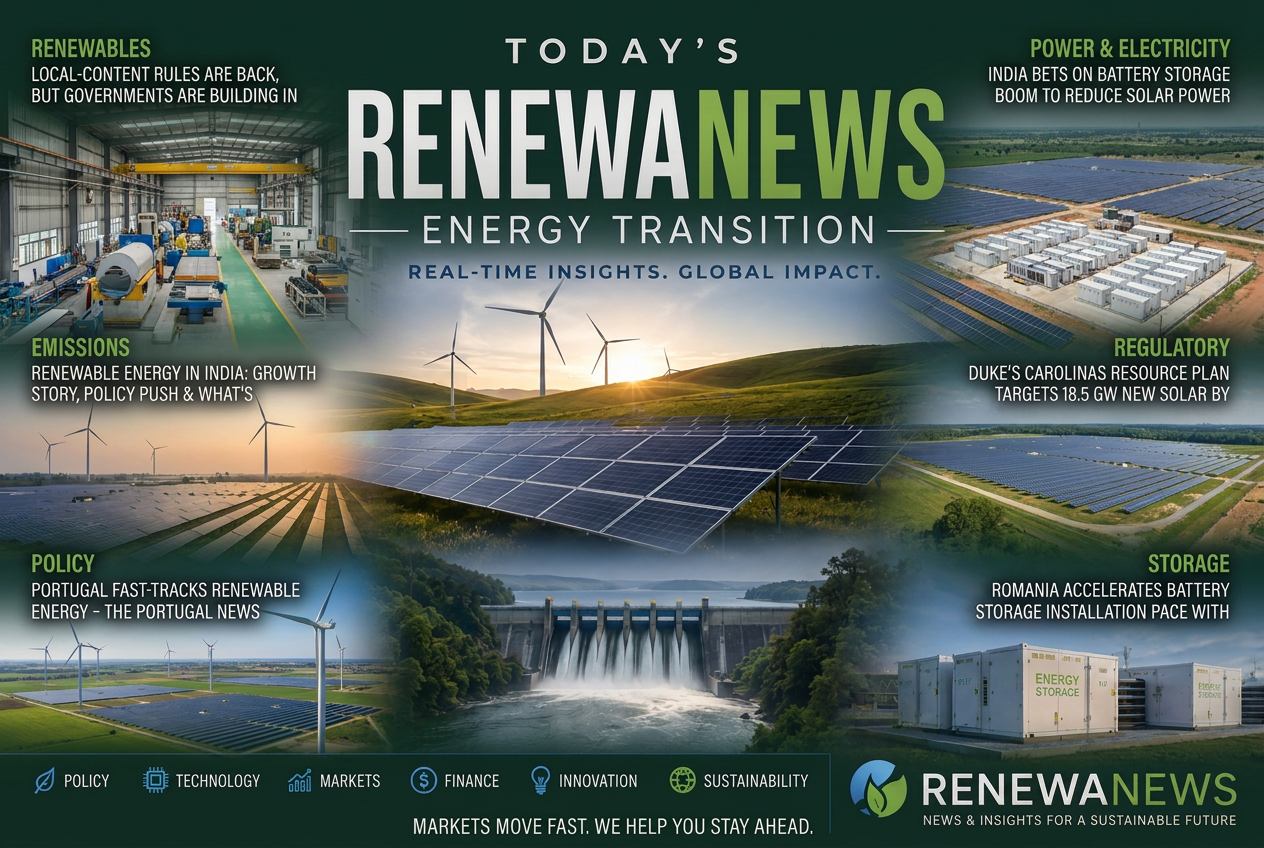
Regulatory
India, Pakistan and Malaysia have rewritten local-content and solar market-access rules over two years, each building phased timelines and exemption windows instead of flat immediate mandates.
From Our Desk
India's renewable buildout signals continued policy support and capital prioritization toward power-sector decarbonization, which can reshape long-term electricity demand growth for gas and other fuels. For executives, it underscores that one of the largest growth markets is leaning harder into non-fossil supply, affecting competitive positioning across generation, grid, and industrial power sales.
NewsGram
Duke’s long-range buildout signals that utility capital will continue shifting toward renewable generation and grid support in the Carolinas, which can influence demand for gas-fired capacity, transmission investment, and local project competition. For suppliers and developers, the plan points to a larger addressable market for solar, storage, and related infrastructure as regulators and utilities lock in future resource portfolios.
Utility Dive
This signals how policy and modeling work in Southeast Asia is framing long-range power demand and the role of renewables, which matters for capital allocation into generation, grids, and supporting infrastructure. For oil and gas executives, it is a reminder that the region’s future energy mix may tighten long-term growth expectations for conventional fuels and shift competitive positioning toward lower-carbon assets.
IESR
Wildfire-driven solar losses highlight how climate volatility can disrupt power supply and force executives to treat generation reliability and weather risk as a capital-allocation issue, not just an environmental one. For oil and gas firms with power exposure or electrification plans, it also reinforces the value of diversified energy portfolios and backup generation capacity.
The Times of India
This signals that hydrogen is moving from policy discussion into site-level deployment, which matters because early pilots can shape public-sector demand, permitting, and vendor selection for future projects. For executives, it is a reminder that low-carbon fuels are competing for capital and operational use cases beyond heavy industry.
Quantum Commodity Intelligence
Lower power costs at a water plant indicate that onsite renewable generation is becoming an economic tool for utilities and industrial operators, not just an emissions play. For executives, it signals continued pressure to optimize operating expenses and rethink how reservoir, land, and grid assets can be used to lower energy exposure.
The Cool Down
Midstream
India's push for battery storage signals more spending on grid flexibility rather than just new solar buildout, which matters for executives watching where renewable capital is likely to flow. It also points to efforts to reduce curtailment and improve power reliability, strengthening the case for storage, power infrastructure, and associated technology suppliers.
Energy Connects
Romania’s faster battery buildout signals more grid-flexibility investment, which can ease renewable integration and reduce curtailment risk for power developers and utilities. For executives, it points to rising competition for storage capital in Europe and a market where grid assets are becoming a key allocation priority.
Balkan Green Energy News
Battery storage adoption by electric co-ops signals rising value for distributed resilience and peak-shaving as power costs increase and outage risk matters more. For executives, it points to continued capital shifting toward grid flexibility rather than traditional supply expansion in local power markets.
The Cool Down
Behind-the-meter storage signals that industrial customers are treating electricity reliability and peak-cost management as a core operating expense, which can shift capital toward distributed power assets instead of grid purchases. For energy executives, it also points to rising demand for flexible power solutions in India and a potential reduction in exposure to volatile grid supply and tariffs.
Saur Energy
This points to storage buildout in Alaska, which can improve local power reliability and reduce fuel volatility risk for remote operations. For an executive, it signals continued capital flowing into distributed power assets where grid constraints make storage more valuable than new supply alone.
Electronics For You BUSINESS
A retailer installing on-site solar, batteries, and EV charging signals that large power users are shrinking exposure to grid volatility and using capital to improve energy resilience. For oil and gas executives, that points to slower growth in retail and logistics power demand from the traditional grid and a broader competitive push toward self-supplied electricity and lower-carbon operations.
The Cool Down
This signals continued public-sector support for fuel technologies that can preserve liquid-fuel demand while lowering carbon intensity, which matters to executives watching how policy capital is being steered in major end markets. It also points to Brazil as a test case for biofuel investment and competitive positioning in low-carbon transportation fuels.
Renewables Now
Policy
Portugal’s faster renewable approvals point to a policy environment that could accelerate power-sector investment and shift capital toward clean generation and grid buildout. For executives, it signals stronger competition for conventional fuel demand and a clearer regulatory path for low-carbon projects in Europe.
The Portugal News
Japan's deeper clean-energy ties with Oman signal continued capital and policy attention toward low-carbon projects in a key hydrocarbon exporter. For executives, it suggests more competition for project partnerships and a gradual diversification of Oman’s energy mix that could influence regional gas and power investment priorities.
毎日新聞
Portugal is lowering permitting friction for solar and wind, which signals faster project pipelines and a clearer route for developers to deploy capital. For executives, this can shift renewable investment toward markets with fewer siting bottlenecks and increase competition for development-ready land and grid access in Europe.
Review Energy
This matters because maritime boundary disputes can delay or complicate permitting and infrastructure planning, which affects where capital is willing to back renewable and power projects in the eastern Mediterranean. It also signals a broader geopolitical risk premium for energy investment in the region, even when the immediate project is not oil and gas.
The National Herald
Indonesia’s power-sector rules and grid structure will determine whether renewable targets translate into actual project awards and financing. For executives, the signal is that capital will stay constrained until market design and policy execution reduce transaction and integration risk.
East Asia Forum
Arizona’s backlash against solar points to a tougher policy and permitting environment for renewable development in a key U.S. growth market. For executives, that can slow project pipelines, raise financing risk, and shift capital toward jurisdictions with clearer regulatory support.
Arizona Capitol Times
This signals whether Pennsylvania’s policy environment will support more distributed generation and utility-scale solar investment. For executives, the key issue is whether the state is becoming a more attractive place to commit capital in power supply buildout and grid-related development.
TribLIVE.com
Markets
Higher solar output in Türkiye signals continued growth in non-fossil electricity supply, which can pressure gas and power market demand during peak generation periods. For an executive, it points to a regional shift in capital and competitive attention toward renewables that can affect balance-of-system spending and power price formation.
Daily Sabah
Turning abandoned coalfields into heat and clean-energy assets signals a reuse of existing industrial sites rather than a greenfield buildout, which can reduce development friction and create a lower-cost path to decarbonized local energy supply. For executives, it also points to competition for land, infrastructure, and policy support in mature energy regions where redevelopment can unlock new revenue streams.
Reasons to be Cheerful
This points to continued capital flowing into EV charging and associated infrastructure, which can affect power demand and competing land-use or corridor access in markets where oil and gas operators also need rights-of-way and grid capacity. The workforce component also signals that clean-energy buildout is becoming a labor and execution issue rather than just a policy theme.
PR Newswire
This signals continued capital deployment into power assets outside the core oil and gas portfolio, which can diversify revenue and reduce exposure to hydrocarbon price swings. For executives, it also points to growing competition for project capital in regions where electrification and renewable buildout may shape future energy demand.
caspiannews.com
Drilling
This signals that graphite and other critical minerals are staying close to federal industrial policy, which can redirect capital toward Canadian supply chains tied to electrification and defense. For an executive, the Lac Knife study suggests the project is moving toward a more financeable, power-intensive development path, which affects competitive positioning in the battery-materials market.
Thailand Business News