AEMO's Grid-Forming Push Turns Fault-Current Capability Into a Connection Gate for New BESS
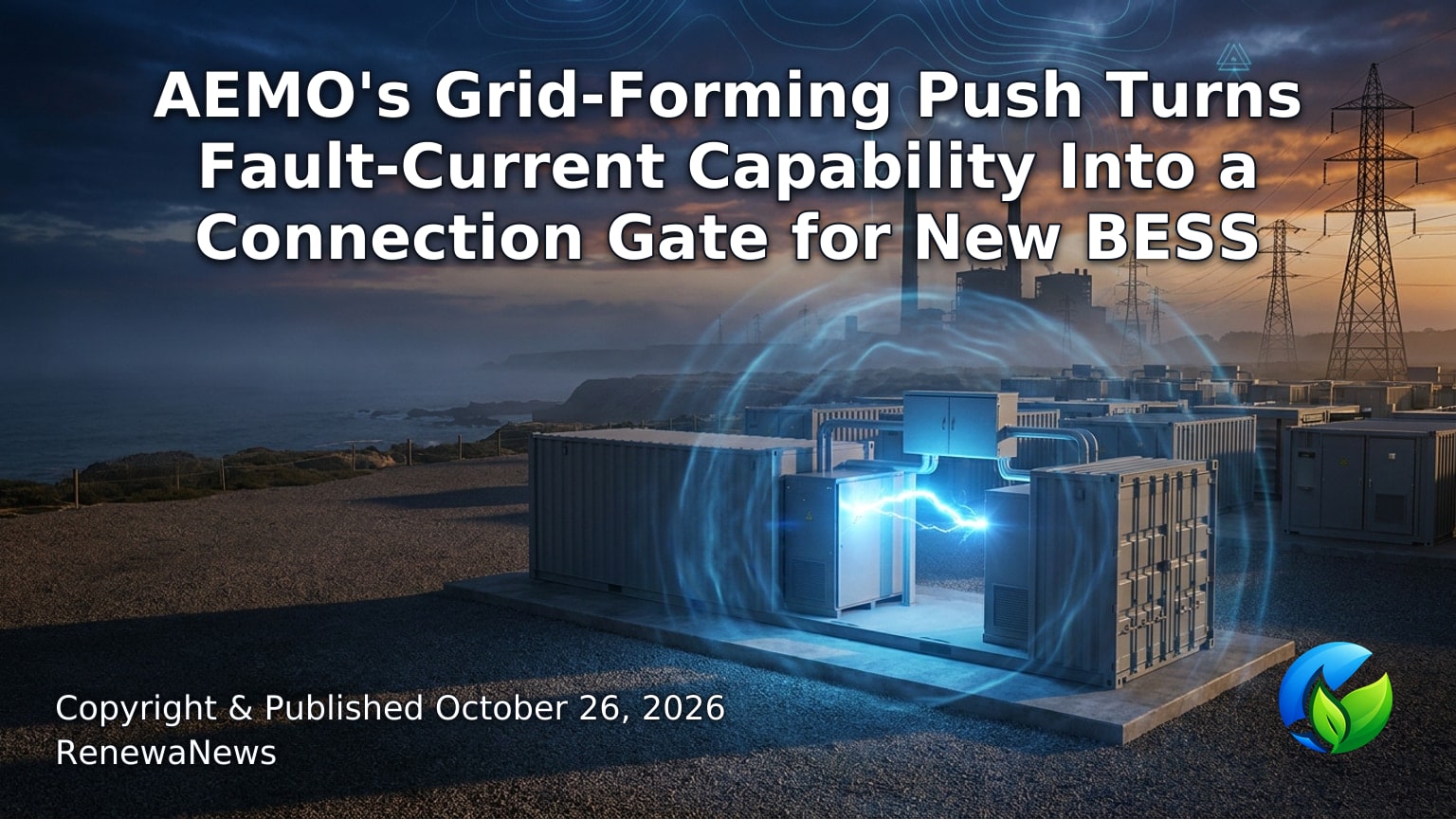
Original illustration created for RenewaNews.

AEMO's Grid-Forming Push Turns Fault-Current Capability Into a Connection Gate for New BESS
The Waratah Super Battery reached Final Commercial Operation Date in October 2026, built, according to Akaysha Energy, to meet "the industry's most demanding grid-code requirements" — a specification built around compatibility with the System Integrity Protection Scheme and grid-forming control. Akaysha Chief Commercial Officer Paul Curnow said the 850 MW / 1,680 MWh project is structured to support reliability and affordability through a revenue-sharing arrangement with NSW customers. Grid-forming capability has stopped being a differentiator for large batteries connecting to the National Electricity Market and started being the baseline AEMO now designs around.
From Trial to Business as Usual
AEMO's FY26 Engineering Roadmap, reported by Renew Economy on September 23, 2026, moves grid-forming inverters from trial status to what the outlet described as "business as usual" for frequency and inertia management. From December 2026, these workstreams fold into the Transition Plan for System Security, which requires detailed workplans addressing system strength and transient stability.
AEMO specialist engineer Andrew Halley told Renew Economy that grid-forming capability is now essential for providing "protection quality fault current" as synchronous generation retires. That phrase is not marketing language. It points to a specific engineering problem: without sufficient fault current, protection relays across the network cannot detect and isolate faults quickly enough, and that gap grows as coal units close.
The urgency behind that language traces to a procurement AEMO ran well before the roadmap went public. A Statement of Need sought what AEMO termed "Type 2 transitional services" to test whether grid-forming inverters could deliver fault current of sufficient magnitude and duration for relay protection. AEMO's published timeline called for contract awards in June 2026 and trial commencement the following month. Nothing in AEMO's public material confirms who was awarded that contract or what the trial has shown since; that gap matters because the trial result is supposed to be the technical precursor underpinning the mandate now moving into connection agreements.
The Pipeline Is Already Grid-Forming Heavy
AEMO's Q3 2026 connection scorecard, reported through PV Tech on October 22, 2026, put the total NEM connection pipeline at 80.9 GW, up 43% year over year. PV Tech's write-up states that grid-scale battery storage accounts for 55% of projects in the queue and that AEMO is prioritizing grid-forming capability within that storage pipeline; AEMO's own scorecard has not been separately checked against that figure, so the 55% share should be read as PV Tech's reporting of AEMO data rather than a confirmed primary number. James Lindley, AEMO's group manager for onboarding and connections, told PV Tech the operator's focus has shifted to getting "viable projects connected and operating."
Neoen's build-out in Queensland shows what that priority looks like at the project level. The developer announced construction of Western Downs Battery Stage 3 on December 10, 2025, a 305 MW / 1,220 MWh addition connecting to Powerlink's Western Downs substation and targeted for operation by the 2027/28 summer. Neoen specified the project will carry grid-forming capability, following Stage 2, which the company said provides grid-reliability and frequency services through the same technology.
Where the Regulatory Friction Sits
Not every part of the industry is reading AEMO's direction the same way. The Clean Energy Council's September 24, 2026 submission to the Australian Energy Market Commission responds to an AEMO rule change request that would require newly connecting inverter-based resources to accept and comply with automated dispatch limits. The CEC's submission dates AEMO's request to May 18, 2026; that filing date has not been independently checked against the AEMC's own rule-change register.
The CEC's objection is specific: the proposal, as drafted, fails to distinguish between grid-following and grid-forming technology, and the council warns it risks penalizing grid-forming assets that are "net-positive for system strength." Limiting grid-forming inverters through the same dispatch-limit framework applied to grid-following units is, in the CEC's framing, "counterproductive" given that grid-forming plants are the technology stabilizing weak parts of the grid in the first place.
That tension — a market operator pushing grid-forming adoption on one track while a parallel rule change threatens to constrain grid-forming output on another — is unresolved in the record available. Neither AEMO nor the AEMC has stated publicly whether the dispatch-limit proposal is intended to apply to grid-forming plant, and no draft determination date has surfaced in AEMO's or the AEMC's published material. AEMO's own technical standards review, launched under National Electricity Rules Schedule 5.2.5 and disclosed by AEMO on August 25, 2025, cited a "rapid increase in the deployment of grid-forming based plants" as the reason for revisiting access standards. AEMO's August 2025 notice said a draft report on the resulting technical requirements would be rescheduled for publication in the third quarter of 2026; nothing in AEMO's available material confirms whether that draft has actually published, despite the piece running after that quarter closed.
Capex: The Number Isn't There
Grid-forming inverters are architecturally different from grid-following units — a grid-following device is a current-source inverter that tracks grid voltage and frequency through a phase-locked loop, while a grid-forming device is a voltage-source inverter that establishes its own reference and can respond within microseconds without waiting on that loop. A NextG Power analysis published August 13, 2026 described that difference as the gap between a "driver" and a "passenger" in weak grids, but NextG Power is an industry newsletter, not a regulator or financier, and it gives no cost figure. No EPC, inverter OEM or financier in the available material puts a number on the capex premium grid-forming specification carries over grid-following. That figure does not exist in what AEMO, the CEC or Akaysha have published, and this piece will not invent one.
What AEMO's 2026 Integrated System Plan does establish is where that unpriced premium will land. The ISP, published June 25, 2026, identifies significant system strength deficits concentrated in New South Wales and Queensland tied to coal retirements, and states that "significant inverter-based resources (IBR) build will require a corresponding investment in system strength services." AEMO's report links grid-forming battery deployment to mitigating those deficits, including in South Australia; the exact chapter language tying specific states to specific mitigation measures has not been checked beyond AEMO's June 25, 2026 publication date, so the state-by-state detail should be treated as AEMO's general framing rather than a quoted commitment.
Operational Plumbing Still Catching Up
Hardware is only part of the shift. AEMO's Inverter Dispatch initiative, detailed in a December 19, 2025 update, aims to automate how inverter limitations are communicated to the market operator, replacing manual coordination with a system suited to high penetrations of inverter-based resources. AEMO's own timeline put an interim solution in front of early adopters in March 2026, with a broader rollout targeted for late 2026; whether that late-2026 rollout has occurred has not been confirmed in the material available, and the piece is running after that window opened.
Until that rollout is confirmed complete, developers are contracting into a framework that AEMO itself has described as still partially manual — a gap that matters for anyone modeling dispatch certainty on a financing timeline measured in years rather than months.
Sources
This article was reported from the following sources.
- A turning point for grid-forming inverters in Australia's grid transition plan — Renew Economy, 2026-09-23
- Dispatch limits for inverter-based resources - CEC submission - AEMC — Clean Energy Council, 2026-09-24
- Waratah Super Battery Fully Operational — Akaysha Energy, 2026-10-09
- Grid-forming Technology (GFM) Access Standards Technical Requirements Review — AEMO, 2025-08-25
- Solar and battery storage push Australia's NEM connection pipeline up 43% to 80.9GW — PV Tech / AEMO, 2026-10-22
- Grid-Forming Inverter Protection-Quality Fault Current Trial — AEMO, 2024-11-08
- Neoen delivers Western Downs Battery Stage 2 and launches Stage 3 in Queensland — Neoen, 2025-12-10
- Grid Forming Inverter BESS vs Grid-Following 2026: The Decisive Technology — NextG Power, 2026-08-13
- Inverter Dispatch - AEMO — AEMO, 2025-12-19
- Appendix A7. System Security - 2026 ISP — AEMO, 2026-06-25