Victoria's Offshore Wind Auction Bets 20-Year Contracts Can Avoid Europe's Failures
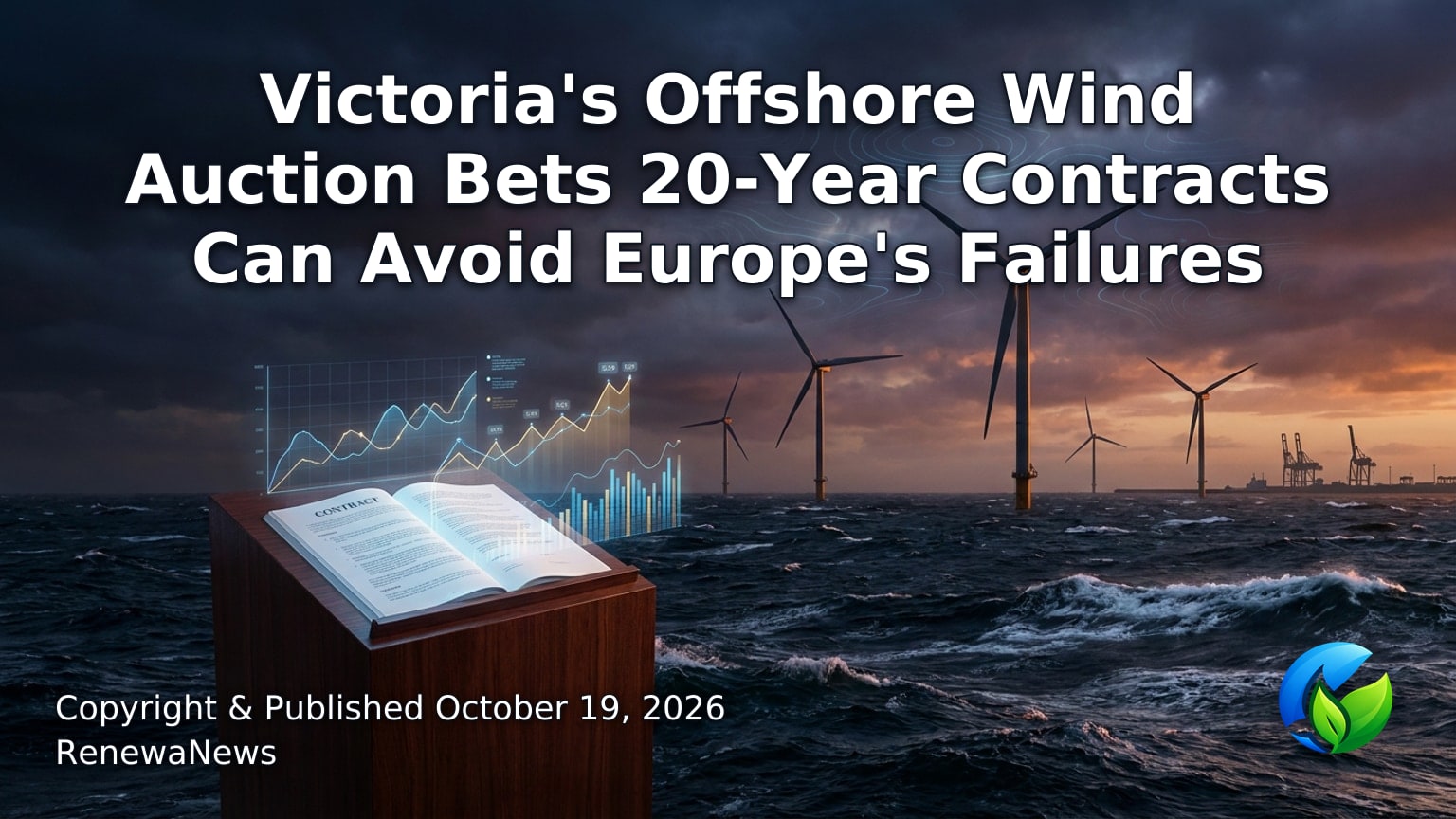
Original illustration created for RenewaNews.

Victoria's Offshore Wind Auction Bets 20-Year Contracts Can Avoid Europe's Failures
Victoria opened the request-for-proposal stage of Australia's first offshore wind auction on August 26, 2026, offering developers 20-year Contracts for Difference for 2GW of capacity in the Gippsland and Southern Ocean zones, according to Herbert Smith Freehills. Renew Economy reported on October 6 that the term exceeds what it described as a "global average" of 10-15 years, though the publication did not specify how that average was calculated or across which markets — a figure worth treating as Renew Economy's characterization rather than an independently confirmed benchmark. The term length itself echoes the 20-year tenor the UK adopted for Allocation Round 7 in January 2026.
The contract length is not incidental. It is the design response to a failure mode that has already played out twice in Europe, and Victoria's auction authority is wagering that copying the fix is cheaper than discovering a new one.
What changed in the contract — and what still isn't on the page
Offshore Wind Energy Victoria's 12-page RFP brochure, published September 16, 2026, confirms the auction will run alongside a novel "Availability Payment" — a fixed, periodic sum paid to developers conditional on the infrastructure being available to generate, independent of output, according to Renew Economy's October 6 reporting. That stacks on top of the 20-year CfD rather than replacing it.
What the brochure does not disclose, at least in what has been reported on it, is the size of that payment, its tenor, whether it is indexed, what availability threshold triggers it, whether it is capped as a share of total project revenue, or how it settles against the CfD strike price. For a lender underwriting the asset, those terms determine whether the payment caps downside meaningfully or merely gestures at one. None of the documents reviewed specify a date by which term sheets resolving those questions are due; the auction itself closes in August 2027, Renews.biz reported on August 26, 2026.
The ESEM question nobody has answered
Analyst Paul McArdle, writing for WattClarity on October 7, argued that the CfD-plus-Availability-Payment structure departs from what the Nelson Review originally recommended. His underlying question is pointed: if Victoria is already writing bespoke contract terms into a state-level auction that is meant to feed into the national Electricity Services Entry Mechanism, what does that say about how uniform ESEM terms will actually be once other states run their own rounds?
ESEM is intended to replace the Capacity Investment Scheme from 2027, per Herbert Smith Freehills' August 27 analysis, and support contracts for this auction are expected to be integrated into that framework. McArdle's point has not been answered publicly by OWEV or the state government in anything reviewed here, which leaves bidders pricing Victoria's terms without knowing whether a federal mechanism will later override them.
The UK comparison
The UK's Allocation Round 7 secured a record 8.4GW of offshore wind capacity in January 2026 using 20-year CfDs at an average clearing price of £90.91 per megawatt hour, according to the UK Department for Energy Security and Net Zero's release dated January 14, 2026. That outcome followed Allocation Round 5 in 2023, in which no offshore wind projects cleared at all because the price cap was set too low relative to developer cost bases.
Victoria has its own failure to avoid repeating. Ørsted project manager Albert Quan warned in September 2025 that a failed first auction would "put a dent in the long-term confidence that investors have in the market," Renew Economy reported on September 19, 2025. The same article noted the state government had to recalibrate its support arrangements after watching high-profile auction failures in the UK and Europe during 2023 — the same period that produced AR5's zero clearance.
Who's actually holding licenses
Nine active feasibility licenses currently sit in the Gippsland zone, according to Energy Victoria's August 26, 2026 listing: Star of the South, Ørsted's Gippsland 01 and 02, Blue Mackerel North, High Sea Wind, Kut-Wut Brataualung, Iberdrola's Aurora Green, Navigator North and Great Eastern. One license holder, the Mainstream/AGL joint venture Gippsland Skies, surrendered its license in January 2026 — a reminder that feasibility status does not guarantee a bid, let alone a contract award. None of the nine remaining holders has disclosed a target clearing price or confirmed it will bid into the August 2027 close.
What the terms don't resolve
Longer contracts and an availability floor address revenue variability. They do not address construction-phase execution risk, which is where offshore wind projects in Europe have blown budgets even after securing a CfD. The RFP brochure confirms developers will be assessed on deliverability, including partnerships with Traditional Owners and community benefit-sharing plans, alongside value for money, according to OWEV's September 16 document.
Layered onto that is a local-content requirement carried over from Implementation Statement 4: an 80% local content target for the operations-and-maintenance phase starting in 2032, and a mandate that 10% of all labor hours on the project be worked by apprentices, trainees or cadets. These social-value criteria are weighted alongside financial bids in the 2026 auction, the Premier's statement confirms, which means a developer with a marginally better price but a weaker workforce plan is not guaranteed to win.
Contracts are awarded in 2028, Renews.biz reported on August 26, 2026.
Why Victoria can't afford a slow queue
The Clean Energy Council stated on August 26, 2026, that CEO Jackie Trad called the auction a "watershed moment" for Victoria's energy system, and the Council cited the 2026 Electricity Statement of Opportunities as identifying reliability gaps in Victoria beginning in 2030-31. That reference to the ESOO runs through the Clean Energy Council's own statement rather than AEMO's document directly, which is worth flagging for anyone pricing the gap against a firmer timeline. S&P Global's August 26 report notes the tender is explicitly meant to replace capacity from retiring coal units at Yallourn and Loy Yang A, plants whose closures are on a schedule the state does not control through this auction alone.
Whether the 20-year CfD and Availability Payment combination proves sufficient will show first in how many of the nine license holders convert feasibility into a formal proposal before the August 2027 close, and second in whether clearing prices land anywhere near the £90.91 per megawatt hour the UK accepted in January.
Sources
This article was reported from the following sources.
- Australia's first offshore wind auction takes shape with longer contracts and special payments — Renew Economy, 2026-10-06
- The Victorian offshore wind auction is live — Herbert Smith Freehills, 2026-08-27
- Victorian developers welcome first Australian auction — Renews.biz, 2026-08-26
- Offshore Wind Energy Victoria (OWEV) — Department of Energy, Environment and Climate Action (DEECA), 2026-09-16
- Victoria opens first offshore wind tender for 2 GW in Australia — S&P Global, 2026-08-26
- Better late than never? There is a lot at stake in Victoria's delayed offshore wind auction — Renew Economy, 2025-09-19
- Record breaking auction for offshore wind secured to take back control of Britain's energy — UK Department for Energy Security and Net Zero, 2026-01-14
- Industry welcomes first offshore wind auctions — Clean Energy Council, 2026-08-26
- Victoria's offshore wind farm locations — Energy Victoria, 2026-08-26
- Offshore Wind in Victoria to receive a CfD and an Availability payment … but where was that structure in the ESEM process? — WattClarity, 2026-10-07
- Next Steps Towards Victoria’s First Offshore Wind — Premier of Victoria, 2025-04-09