Green Ammonia Projects Pivot to Shared Infrastructure to Unlock Scale and Capital
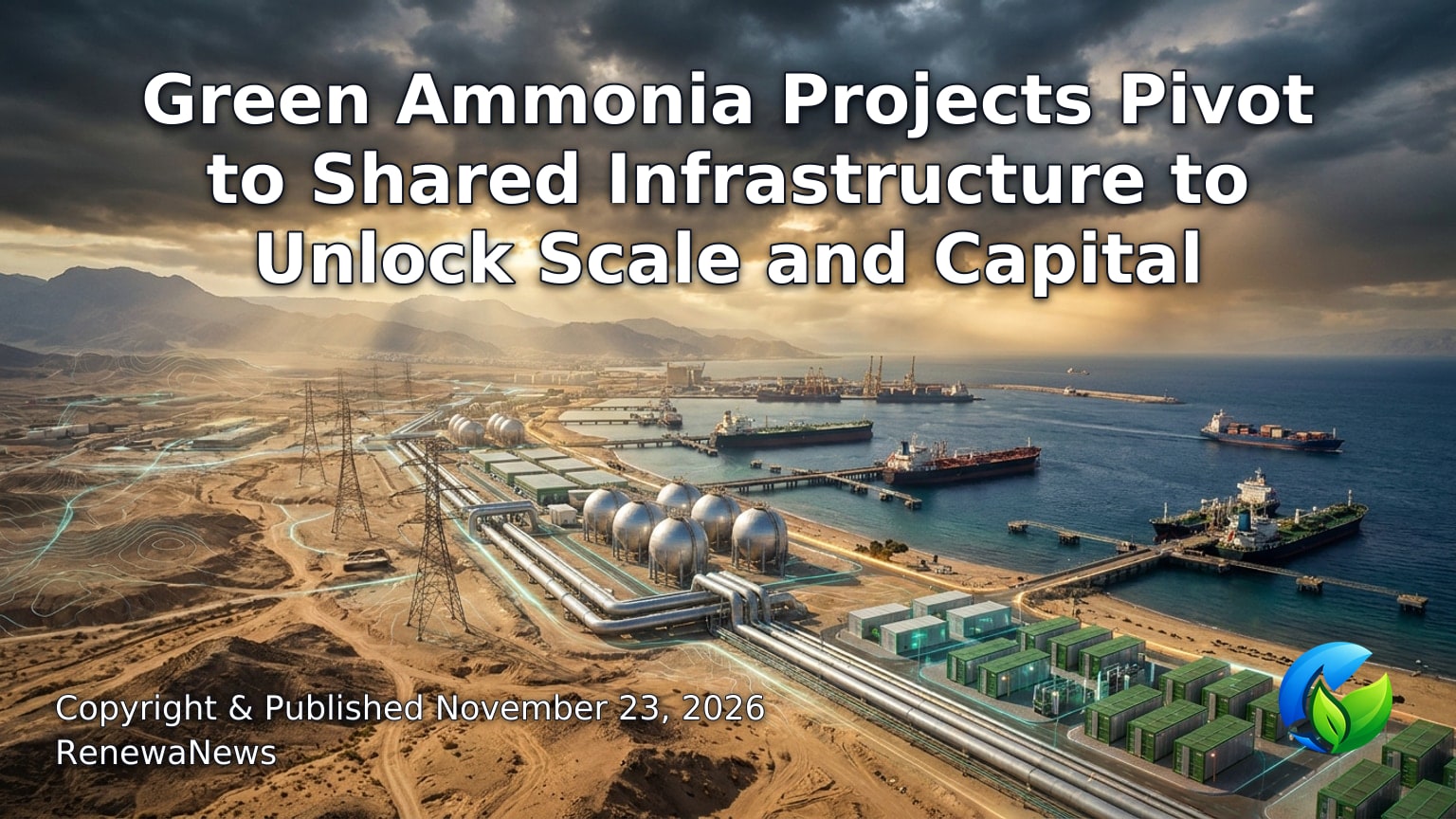
Original illustration created for RenewaNews.

TotalEnergies has formally withdrawn its environmental impact study for the $16 billion H2 Magallanes green hydrogen and ammonia project in southern Chile. Managing director Antoine Liane cited "weak demand for green molecules" and equipment costs that came in higher than expected as the reasons the standalone mega-project became uneconomic.
A single developer financing its own desalination plant, transmission network, storage and export terminal on top of electrolyzer and synthesis-loop costs is a hard structure to make pencil when offtake demand is uncertain. That is the problem the latest wave of Jordanian, Chilean and Moroccan green ammonia announcements is built around solving, by spreading the expensive common assets — ports, water, grid connections — across several tenants instead of one balance sheet.
Jordan presents a $5.36 billion shared hub
Jordan's Ministry of Energy and Mineral Resources presented a $5.36 billion investment package for shared green hydrogen and ammonia infrastructure at the EU-Jordan Investment Conference, held June 11, 2024; Fuel Cells Works published its account of the package on November 20. The package funds common-use electricity and hydrogen transmission networks, a desalination plant and ammonia storage tanks inside a 5.5-square-kilometer "Green Hydrogen Hub" in Aqaba, with $4.5 billion of that spend targeted for completion by 2030. The hub is designed to serve nine developers currently running feasibility studies on the same site.
Energy and Mineral Resources Minister Saleh Kharabsheh said the country's green hydrogen infrastructure will operate under "open-access rules" that let multiple developers use the same facilities. The framework covers hydrogen transport networks, the desalination plant, storage and an export terminal at Aqaba Port.
The EBRD has been working this problem in Jordan since before the latest announcement. A 2024 EBRD brief on the country's hydrogen plans described support for resolving land, water and infrastructure barriers through common-use facilities, noting 13 projects were then operating under memoranda of understanding in the Aqaba region. The jump from 13 MoU-stage projects in February 2024 to nine developers running active feasibility studies by November 2026 suggests the shared-infrastructure pitch is converting interest into technical work, even if it has not yet converted into final investment decisions.
Not every Aqaba project is waiting on the shared hub to proceed. Jordan Green Ammonia, a joint venture between Hynfra and Fidelity Group, signed a 45-year lease for 30 hectares in Aqaba's South Industrial Zone for a $1.1 billion plant designed to be grid-independent, with its own solar generation and desalination facilities. JGA Chairman Wael Suleiman said the plant will produce 120,000 tonnes of green ammonia annually, feeding the domestic phosphate industry and export markets. JGA's self-contained design sits next to, not inside, the ministry's open-access hub.
Chile's dock agreement predates Total's exit
Chile's Magallanes region had already moved toward a shared model before Total's withdrawal. HIF Global and the state oil company ENAP signed an agreement to modernize the Cabo Negro docks and surrounding infrastructure for shared use among ammonia and synthetic fuel developers, HIF Global said in a statement dated September 6, 2024, with ENAP taking a shareholding stake in HIF's projects. Chilean Finance Minister Mario Marcel said, in that same September 6 statement, that the agreement moved the region beyond "abstractions" and into the logistical commitments that get plants built. TotalEnergies' withdrawal does not prove the shared-port model would have saved H2 Magallanes — the project cited demand and cost problems that a dock agreement would not fix — but it leaves the shared-infrastructure track as the one still moving in the same region.
Washington backs a FEED study in Western Sahara
The US Trade and Development Agency signed a $5.7 million grant agreement in July 2026 to finance front-end engineering design work for a $4.5 billion green ammonia facility planned for El Aaiún in Western Sahara. That figure, and the characterization of the grant as the first direct US government financial support for a private investment project in the territory, come from Western Sahara Resource Watch, an advocacy group focused on the territory's contested status; no independent confirmation from USTDA or the ORNX consortium appears in the available record. The project is being developed by ORNX — Ortus Power Resources of the US, Spain's Acciona and Germany's Nordex — and would use technology from GE Vernova and Electric Hydrogen, per WSRW's July 28, 2026 account.
A $5.7 million FEED grant is a small outlay against a $4.5 billion facility, but it buys bankable engineering before equity or debt is committed — the same logic Jordan and Chile are applying at the infrastructure layer rather than the study layer.
Morocco's larger, single-anchor version
Morocco's OCP Group has run a version of this longer, built around one dominant developer rather than an open multi-tenant hub. Worley was scheduled to commence front-end engineering design in September 2024 on OCP's $7 billion green ammonia project in the Tarfaya region, ESG News reported on August 28, 2024; the plant targets 1 million tonnes of annual green ammonia production powered by a 2.8 GW wind farm, 1 GW of solar PV and 2.7 GWh of battery storage. Those figures date to that single mid-2024 report and have not been updated since in the available record. OCP separately signed a joint development agreement with Engie in November 2024 covering renewable power, storage and desalination; CEO Mostafa Terrab called the approach the building of "integrated production ecosystems."
The World Bank estimated, in an August 2024 report, that global investment in hydrogen infrastructure could reach $5 trillion by 2050, and said it was advising on shared-infrastructure projects in Brazil, India, Mauritania, Namibia and South Africa to lower the cost of capital for private developers.
Jordan's nine Aqaba developers are still at feasibility stage, and Western Sahara's project has a FEED grant rather than a financing package. What has changed since Total's exit is which projects are still standing: the ones attached to shared ports, shared transmission or public co-investment, rather than the one that tried to build an entire green ammonia value chain alone.
Sources
This article was reported from the following sources.
- Green Hydrogen Infrastructure to Operate Under Open-Access Rules, Says Minister — Hydrogen Central, 2026-11-17
- Jordan unveils $5.36 billion green hydrogen and ammonia infrastructure investment plan — Fuel Cells Works, 2026-11-20
- TotalEnergies drops USD16bn H2 Magallanes project in Chile — Enerdata, 2026-11-19
- Trump administration bankrolls ammonia project in occupied Western Sahara — Western Sahara Resource Watch (WSRW), 2026-07-28
- OCP and Engie eye green hydrogen and ammonia collaboration — Offshore Energy, 2024-11-04
- Jordan Green Ammonia secures land for production in Aqaba — Inspenet, 2026-11-22
- Shared Infrastructure for Clean Hydrogen — World Bank, 2024-08-31
- Worley to Begin Key Phase of $7 Billion Green Ammonia Project in Morocco — ESG News, 2024-08-28
- HIF Global and Enap sign agreement to accelerate e-Fuels in Chile — HIF Global, 2024-09-06
- Green Hydrogen Common Infrastructure Development in Jordan — EBRD, 2024-02-14