Grid Bottlenecks Now Primary Constraint on Global Clean Energy Transition
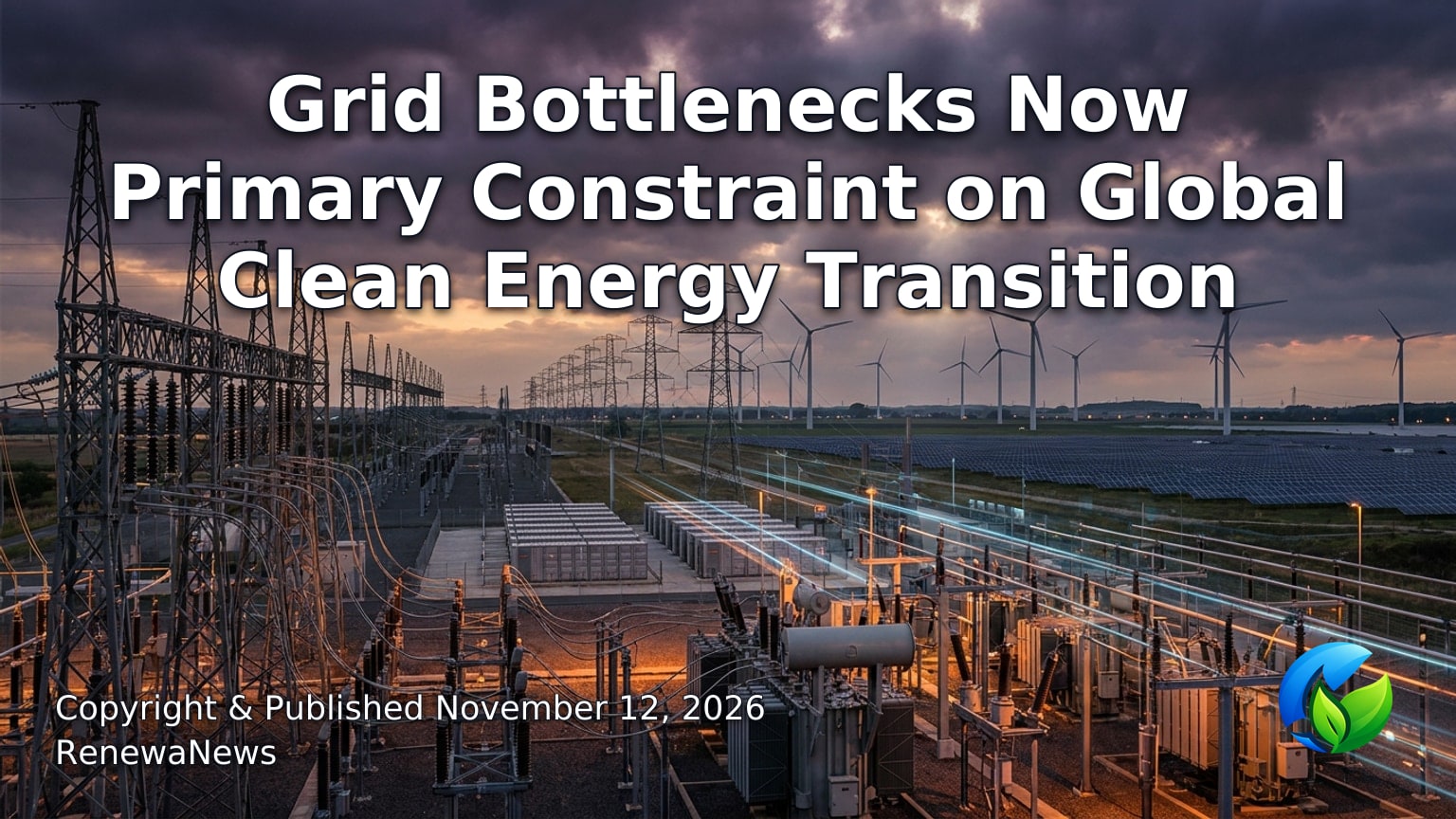
Original illustration created for RenewaNews.

Grid Bottlenecks Now Primary Constraint on Global Clean Energy Transition
Speaking at COP31 on November 12, 2026, the UN Secretary-General told delegates that electricity networks need a 50% increase in investment by 2030 to connect renewable projects that are already financed but stuck outside the grid, according to Anadolu Ajansı's report from the summit. The warning did not single out a region. It described infrastructure, not technology or cost, as the binding constraint on meeting climate targets, with the acute cases concentrated in developing nations.
The Queue Keeps Growing
The scale behind that warning is measurable. As of the end of 2025, roughly 8,200 projects representing 1,312 GW of generation and 749 GW of storage were actively seeking interconnection in the United States, according to Lawrence Berkeley National Laboratory's Queued Up: 2026 Edition, published June 1, 2026. Solar and storage dominate that backlog.
That earlier edition, LBNL's Queued Up: 2024 Edition, covering the end of 2023, put the total U.S. queue at 2.6 TW. Only 19% of projects that requested interconnection between 2000 and 2018 ever reached commercial operation. Those are the mechanics behind the backlog, not an abstraction.
What is independently sourced is the IEA's own October 2023 report, Electricity Grids and Secure Energy Transitions, which called grids the "weak link" of the transition.
SUNJ's account of that same IEA report frames the backlog as a grid failure, not a generation failure: completed projects exist; the wires to move their output do not.
Data Centers Jump the Line
The United Kingdom offers a close-up view of how fast a queue can move when demand, not just generation, enters it.
Ofgem is now implementing a "first ready, first connected" model and weighing a data center commitment fee designed to push speculative applications out of the queue. The mechanism matters beyond the UK: it is an admission that queue position, not generation cost, now determines which projects reach the grid first — and that renewable developers are competing for that position against a demand source that did not exist in the queue three years ago.
The Money Question
Grid investment is already the third-largest category of global energy transition spending.
A more recent BNEF report, Financing Grid Buildout: Mobilizing Capital Across Models, published November 10, 2026, argues the gap is starting to close through a change in how transmission gets financed rather than through government appropriations. Transmission projects are increasingly structured as discrete, bankable assets suitable for project-level financing and independent transmission models, with private debt and concession structures taking on a larger share of what was previously utility balance-sheet spending. For developers used to financing generation and storage, that is a new counterparty type to learn — and a new set of lenders now pricing grid risk the way they once priced merchant power risk.
Policy Catches Up, Slowly
Regulators on both sides of the Atlantic have moved, if not yet at the pace the backlog demands. The U.S. Federal Energy Regulatory Commission issued Order No. 1920-A on November 21, 2024, requiring transmission providers to conduct long-term regional planning on a 20-year forward-looking basis, with the first planning cycle beginning within two years of compliance filings — an explicit attempt to address what FERC itself called "unnecessary delays" in prior reform efforts.
The European Commission moved on a parallel track. Its European Grids Package proposes revisions to the TEN-E Regulation and amendments to the Renewable Energy Directive aimed at accelerating permit granting, improving EU-level coordination on infrastructure mapping, and building more effective cost-sharing tools across member states. Neither the FERC rule nor the EU package shows results yet in the queue data; both set multi-year clocks running.
What the Technology Can't Fix
Part of the bottleneck is physical, not regulatory. The IEA's February 25, 2025 report, Building the Future Transmission Grid, found that growing infrastructure needs are driving up prices and lead times for the components — transformers, high-voltage cable, switchgear — that any expansion depends on, and recommended long-term procurement mechanisms and coordinated planning specifically for lines exceeding 66 kilovolts.
The IEA's more recent report, Modernising Grids in the Age of Electricity, turns to what can be done with the grid that already exists. New transmission lines have become "increasingly slow and costly to build," the report states, and it examines how network operators can deploy AI and digital tools to optimize existing capacity rather than wait years for new steel in the ground. The same report flags data centers as a fast-growing demand source that can worsen congestion even as AI tools improve system reliability and situational awareness elsewhere on the network — a tension the Ofgem case illustrates directly.
None of this changes the arithmetic facing a developer with a signed PPA and a project sitting in year four of an interconnection study. The IEA's own numbers, from 2023 through 2026, describe a backlog that has grown faster than the policy and financing responses built to clear it. For capital allocators, the queue position of a project — not its levelized cost — is increasingly the number that determines when, or whether, it ever generates revenue.
Sources
This article was reported from the following sources.
- UN chief warns grid bottlenecks stall clean energy transition at COP31 — Anadolu Ajansı, 2026-11-12
- Financing Grid Buildout: Mobilizing Capital Across Models — BloombergNEF, 2026-11-10
- Can Ofgem's connections reform consultation deliver for UK data centres? — Capacity Global, 2026-11-06
- Modernising Grids in the Age of Electricity — International Energy Agency (IEA), 2026-09-21
- Queued Up: 2026 Edition, Characteristics of Power Plants Seeking Transmission Interconnection As of the End of 2025 — Lawrence Berkeley National Laboratory (LBNL), 2026-06-01
- 2,500 GW of Global Renewable Energy Projects Stuck in Grid Queues — SUNJ (referencing IEA Electricity 2026), 2026-06-01
- BloombergNEF Finds Global Energy Transition Investment Reached Record $2.3 Trillion in 2025 — BloombergNEF, 2026-01-26
- European Grids Package — European Commission, 2025-12-10
- Building the Future Transmission Grid — International Energy Agency (IEA), 2025-02-25
- Significant Investment Needed to Ready the Global Power Grid for Net Zero — BloombergNEF, 2024-12-20
- Explainer on the Transmission Planning and Cost Allocation Final Rule - Order No. 1920 — Federal Energy Regulatory Commission (FERC), 2024-11-21
- Queued Up: 2024 Edition, Characteristics of Power Plants Seeking Transmission Interconnection As of the End of 2023 — Lawrence Berkeley National Laboratory (LBNL), 2024-04-09
- Electricity Grids and Secure Energy Transitions - Executive Summary — International Energy Agency (IEA), 2023-10-17