Offshore Wind Stop-Work Orders Cost $5 Million a Day as Domestic-Content Deadlines Compound US Delays
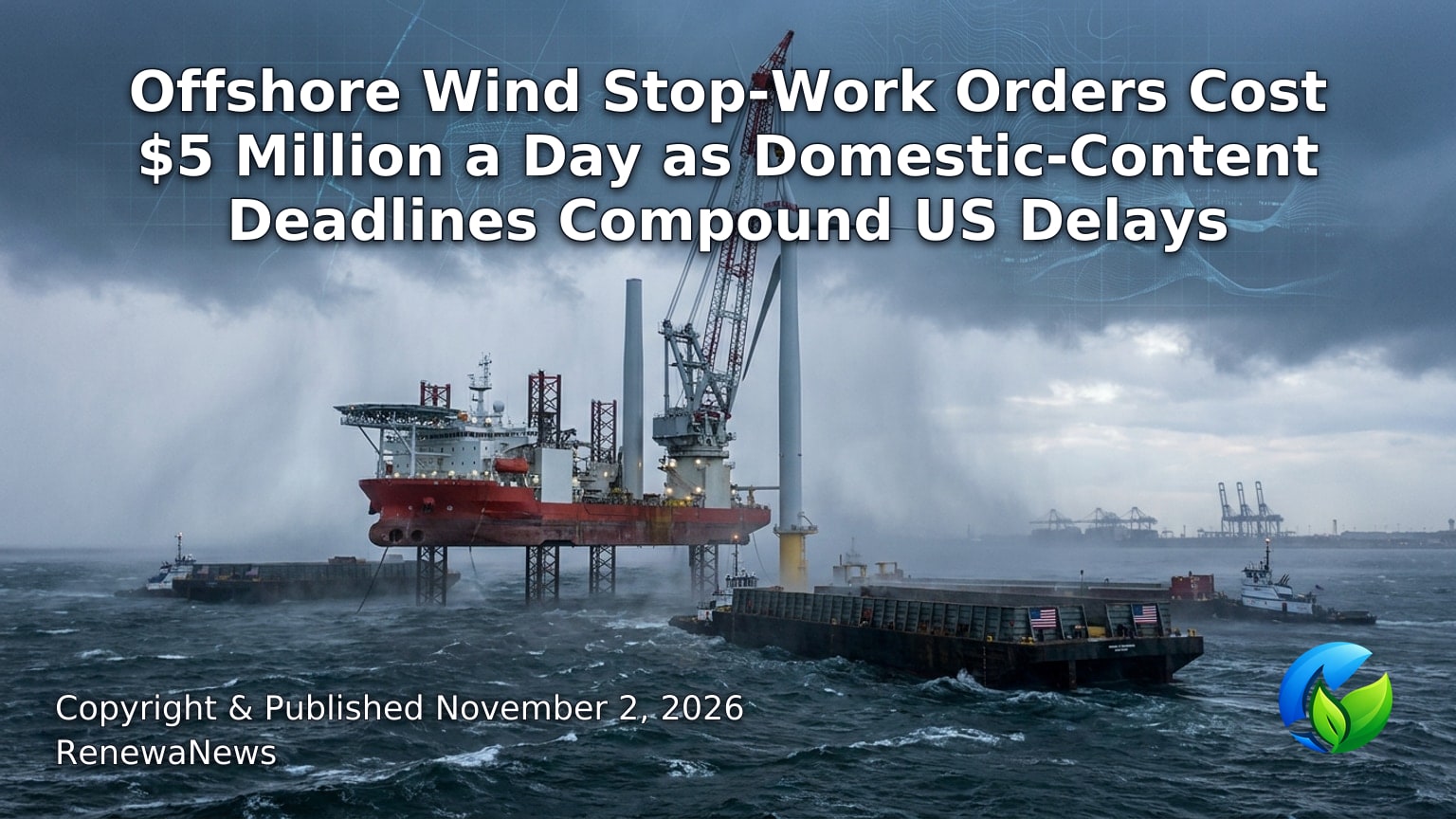
Original illustration created for RenewaNews.

Equinor's 810 MW Empire Wind 1 is now about 80% complete, but first power has slipped to the first half of 2027, CFO Torgrim Reitan confirmed, Splash247 reported October 30, 2026. The delay traces to the construction of specialized US-built tugs and barges needed to meet Jones Act requirements for turbine installation — a vessel-manufacturing bottleneck inside a compliance regime, not a new permitting dispute. Equinor still expects to monetize roughly $2.5 billion in US investment tax credits between 2027 and 2028, a figure that depends on the project actually reaching commercial operation on the revised schedule.
New York walks away from its own auction
NYSERDA ended its fifth competitive offshore wind solicitation without awarding a single contract, the authority confirmed on February 17, 2026. The round had drawn 25 proposals from four developers — Equinor, Ørsted, Vineyard Offshore, and Community Offshore Wind — covering 6,870 MW of capacity. A NYSERDA spokesperson said it would not be "prudent to enter into new long-term purchase and sale agreements" given federal actions that were, in the authority's words, "disrupting the offshore wind market and instilling significant uncertainty." A state that has run four prior solicitations successfully just declined to contract for nearly 7 GW because the federal backdrop made the economics unenforceable.
The domestic-content table changed in January 2025
Treasury's Notice 2025-08 updated the domestic-content calculation table developers use to qualify for bonus investment tax credits, Norton Rose Fulbright reported on January 20, 2025. For offshore wind the math stayed punishing: if nacelles aren't US-manufactured, developers must source blades, rotor hubs, and power converters domestically to hit the required thresholds. The new rules apply to projects that started construction after January 16, 2025, creating a narrow window for developers to lock in the simpler 2024 calculation method.
That change sits on top of a broader freeze dating to a January 20, 2025 presidential memorandum that halted offshore wind permitting and leasing nationwide, according to a Georgetown Climate Center analysis published February 5, 2026. Federal agencies — Georgetown's report does not specify which — have since rescinded designated Wind Energy Areas and canceled $679 million in federal funding across 12 projects in California, Maryland, and Massachusetts. Developers and states are increasingly turning to litigation rather than negotiation, Georgetown notes, treating the risk as existential rather than operational.
Revolution Wind finished the turbines and still needs a court order
Ørsted and Skyborn Renewables installed the 65th and final turbine at the $6.2 billion Revolution Wind project, the Maritime Executive reported September 18, 2026. The project is complete in the field. It is not complete on paper: Revolution Wind was operating under a court-ordered preliminary injunction that allowed commissioning to proceed while federal approvals already granted years earlier were reevaluated. Which court issued that injunction, and whether it has since been appealed, was not addressed in the September 18 report — but a fully built 65-turbine project sitting under active litigation is the clearest evidence yet that completion no longer guarantees revenue.
Gulf of Maine pricing already reflected the risk
Even before the 2025 freeze, lease economics in newer frontiers were softening. The first Gulf of Maine floating offshore wind auction produced just $21.9 million in winning bids across four lease areas, OffshoreWIND.biz reported on October 30, 2024 — $71 million less than a prior fixed-bottom sale in the Central Atlantic. Avangrid Renewables and Invenergy NE Offshore Wind were the provisional winners. Avangrid CEO Pedro Azagra said the roughly 3 GW of potential across the company's leases "reinforces their commitment to New England."
Hardware risk hasn't gone away either
A July 2024 blade failure at Vineyard Wind 1 forced GE Vernova and the project to remove seabed debris and a hanging blade section, pushing the companies' projected commercial operation date to late 2025, according to their joint update dated October 23, 2024. The companies implemented a "blade readiness for service" protocol across the remaining 22 installed turbines.
Sources
This article was reported from the following sources.
- Equinor's US offshore wind project faces fresh schedule setback — Splash247, 2026-10-30
- New York Ends Fifth Offshore Wind Solicitation Process 'Due to Federal Actions Disrupting Market' — NYSERDA / Brazil Energy Insight, 2026-02-17
- The Trump Administration Protects U.S. National Security by Pausing Offshore Wind Leases — U.S. Department of the Interior, 2025-12-22
- Updated Domestic Content Calculations | Norton Rose Fulbright — Norton Rose Fulbright, 2025-01-20
- US Offshore Wind Project Revolution Wind Installs Last Turbine — The Maritime Executive, 2026-09-18
- Offshore wind stop-work orders are costing consumers, delaying needed electricity — IEEFA, 2026-01-28
- GE Vernova and Vineyard Wind Provide Update on Incident and Response Action Plan — GE Vernova / Vineyard Wind, 2024-10-23
- Avangrid, Invenergy Winners of First Gulf of Maine Offshore Wind Auction — OffshoreWIND.biz, 2024-10-30
- Understanding Recent Federal Actions | Offshore Wind Development — Georgetown Climate Center, 2026-02-05
- US Offshore Wind 2025, $400M National Grid Impairment — Enki AI, 2026-09-24