Global Energy Transition Investment Shifts to Grids and Storage as Policy Uncertainty and Supply Chains Reshape Returns
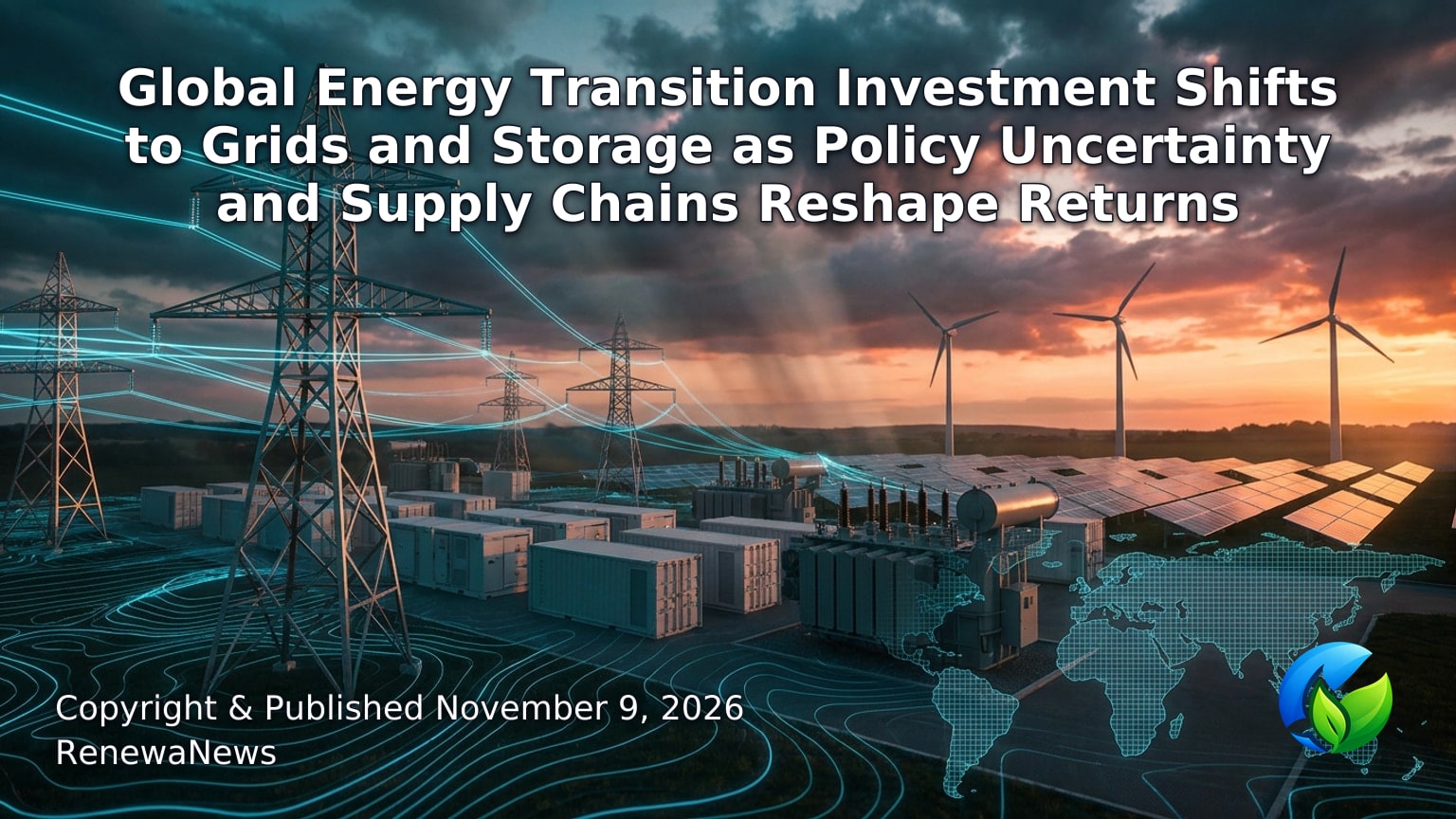
Original illustration created for RenewaNews.

Clean energy investment is set to rise 6.5% to $2.2 trillion in 2026, but the composition underneath that total is shifting hard: grid spending is climbing 21% and storage 36%, while investment in renewable generation itself is dipping, according to Allianz Research's Green Transition Tracker, published November 5, 2026.
Grids are no longer the sideshow
BloombergNEF's NEO Grids 2026 report, published October 30, models cumulative global grid capital expenditure at $16.5 trillion between 2026 and 2050 under its Economic Transition Scenario. Distribution investment accounts for over half of that spending. BNEF describes elevated grid spending as an "enduring feature" of the transition rather than a temporary surge tied to any single buildout cycle.
The IEA's World Energy Investment 2026, published May 28, sizes the stakes: global energy investment is projected to hit a record $3.4 trillion this year, with electricity accounting for nearly 60% of the total, and renewables still representing 70% of power generation investment. The report flags more than 2,500 gigawatts of projects stalled in connection queues worldwide and says annual grid investment needs to rise 50% by 2030 from its current $400 billion base.
A US storage upgrade, not a global one
BloombergNEF's November 6 note on US clean power — titled "US Clean Power Rises With Data Centers" — raised its US energy storage forecast by 34%, to 383 gigawatts of cumulative additions through 2036, while cutting its US utility-scale solar forecast by 7.5%, to 430 gigawatts over the same period. BNEF attributes the divergence to new solar-specific import tariffs weakening project economics and to AI data centers that need firm, flexible power rather than intermittent output. Restrictions on foreign-made inverters and bulk-power equipment are named as additional risks to the deployment outlook.
Global Energy Monitor's June 15 report on storage and renewable grids says battery energy storage system costs fell 93% between 2010 and 2024, and that BESS now account for the majority of new storage additions worldwide. Combined installed wind and solar capacity has reached 3,222 gigawatts AC, per GEM's 2026 Global Wind and Solar Power Tracker, and new capital is increasingly going toward co-locating storage with existing generation rather than building standalone plants. Chile, GEM notes, is planning record shares of co-located storage specifically to avoid the curtailment problems it saw in 2025.
What UN negotiators said in Antalya
At the UN climate talks in Antalya, Turkey, Special Adviser Selwin Hart called for a "massive, massive, massive scaling up" of grid investment, the Associated Press reported on November 9. The UN used the summit to launch a "Global Grids Accelerator" aimed at mobilizing funding for Africa and Southeast Asia. AP's report cited an IEA figure presented at the talks: generation investment has risen 70% since 2015, while annual grid spending has grown at less than half that pace.
IRENA's World Energy Transition Outlook, published October 13, puts a price on closing that gap. Director-General Francesco La Camera said the transition is "under pressure" because renewable growth alone cannot meet rising demand. The report calls for $10.3 trillion in annual investment through 2050 — a target for the system IRENA says is required to stay on a 1.5°C path, not a forecast of current spending, which the IEA puts at $3.4 trillion across all of global energy this year. IRENA also projects that electricity's share of global final energy consumption must rise from 23% as of its October report to 35% by 2035.
Where the behavior is: manufacturing scales, deployment hesitates, gas wins the race
Rhodium Group's Clean Investment Monitor, in its October 15 report on US clean energy supply chains, found that domestic manufacturing capacity for battery cells and solar cells has doubled since early 2025. Long-term demand projections for that capacity are being dragged down by policy changes and permitting constraints, the report says, including the repeal of federal greenhouse gas emissions standards for vehicles. Manufacturing investment remains high even as deployment faces tightening regulatory headwinds.
That split shows up more sharply in ACORE's July 15 survey of clean energy investors, prepared with S&P Global. The survey found that 2026 remains a record year for investment as developers race to lock in tax credits before they expire, but policy and interconnection uncertainty rank as the top risks cited for 2027 and beyond. It also found a surge in M&A activity for natural gas-fired generation, as AI companies move to secure immediate power supply, sometimes ahead of longer-lead renewable projects. ACORE does not quantify the scale of that M&A activity or disclose how many investors were surveyed, so the finding should be read as directional. Still, it is the clearest signal in this stretch of reporting that capital allocators are treating 2026 as a window to close out credit-era projects before turning to whatever comes after the cliff.
Scenario planning for a fractured system
S&P Global's "In Search of Resilience" report, published September 4, introduces three scenarios — Adaptation, Fracture and Renaissance — built around the idea that resilience now means balancing decarbonization against import exposure and supply chain security, not just withstanding physical shocks. In the Fracture scenario, trade barriers and geopolitical disruption push the system toward localized energy networks, raising the cost of the transition and reshaping the returns investors can expect globally.
Sources
This article was reported from the following sources.
- World Energy Investment 2026 — International Energy Agency (IEA), 2026-05-28
- World Energy Transition Outlook 2026: 1.5°C Pathway — International Renewable Energy Agency (IRENA), 2026-10-13