Europe's Hydro Giants Have 25 GW of Spare Grid Capacity, and Developers Are Finally Using It
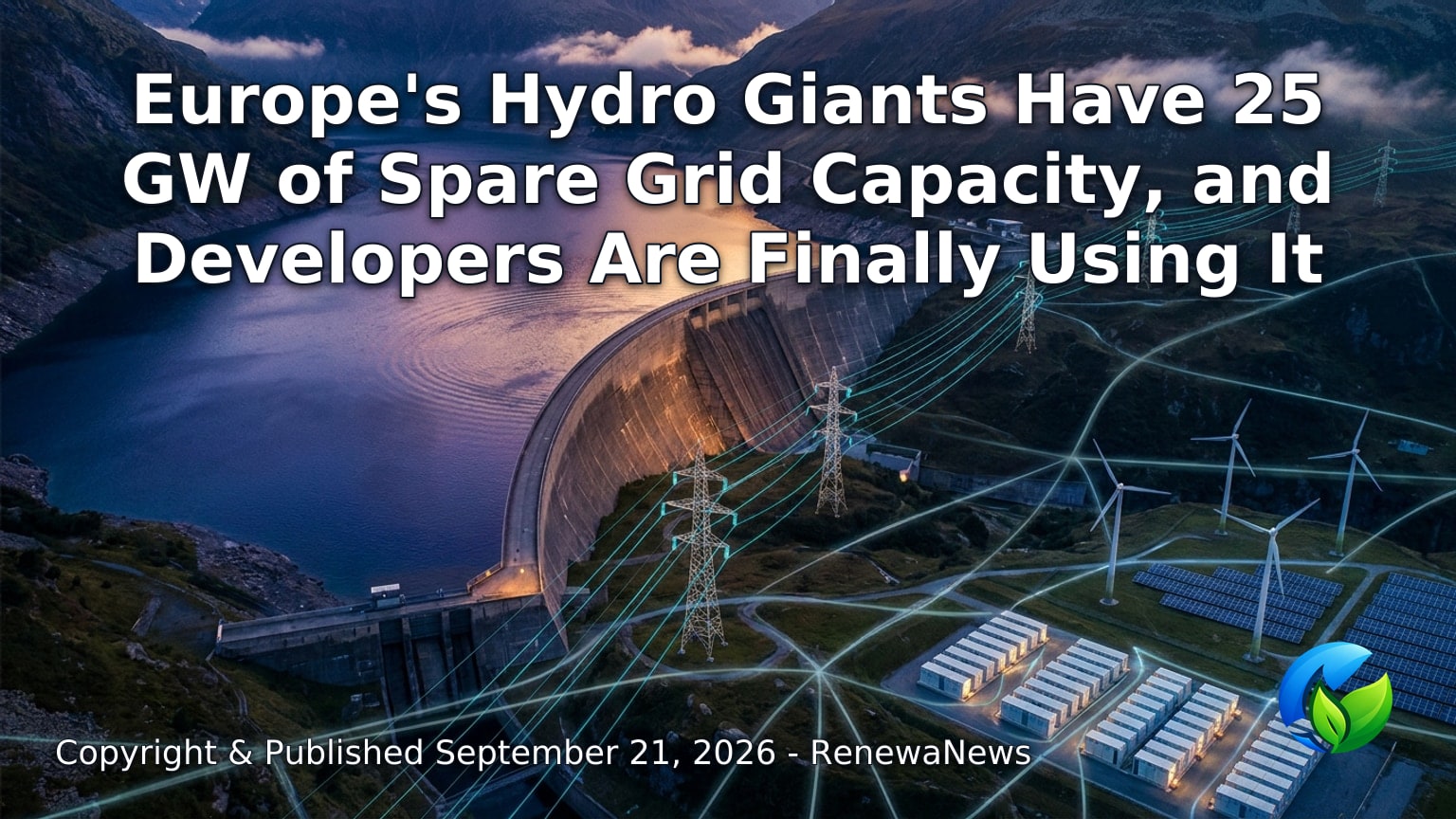
Original illustration created for RenewaNews.

Europe's Hydro Giants Have 25 GW of Spare Grid Capacity — and Only Two Countries Have Rules to Use It
Seven European countries hold hydropower plants running on grid connections built decades ago for stations twice their current headroom. According to a report published by Ember, hydro giants across Austria, Bulgaria, France, Italy, Portugal, Romania and Spain use only 19% of their grid connection capacity on average — leaving room to co-locate as much as 25 GW of new wind and solar without a single new transmission line. Only two of those seven countries, Spain and Portugal, currently have rules that let a developer build that kind of project.
Elisabeth Cremona called hybridization an "immediate, zero-intervention solution" for countries stuck in permitting and connection queues. The pitch is straightforward: instead of waiting years for a new substation, a developer plugs wind or solar into a hydro plant's existing connection point and shares the headroom the hydro asset was never using.
The scale of the unused headroom
The seven countries in Ember's study account for 93 GW of the EU's 131 GW of installed hydropower capacity, and hybridization could cover 18% of the new renewables these markets expect to add by 2030 without requiring any additional grid capacity — both figures from the same Ember report, restated in a write-up by trade outlet Renewables Now. That outlet's own addition to the story is the regulatory picture: frameworks across the seven countries are fragmented, and Spain and Portugal are the only two with dedicated rules for co-located hybrid projects. That gap, not the technology, is what currently decides who can act on Ember's number.
Iberia is where the projects already exist
That regulatory head start shows up in the project pipeline. Iberdrola began commissioning the Tâmega Norte wind farm, linking it to the existing Tâmega pumped-storage hydropower complex in northern Portugal. The wind farm shares transmission infrastructure through the Ribeira de Pena hub rather than drawing its own connection.
EDP moved further down the same path. In a July 29, 2026 announcement, EDP said it had begun testing a battery storage module at its Las Lomillas site in Spain, where 122 MW of combined wind, solar and storage capacity runs through a single 50 MW grid connection — less than half the combined nameplate capacity, made workable because the different technologies rarely peak at the same hour. The same announcement put EDP's hybrid fleet across the Iberian Peninsula at close to 700 MW, anchored by the Alqueva project, which pairs hydropower with floating solar and batteries on the same reservoir. Those figures come from EDP itself; no independent operator or regulator has published a separate count of the fleet.
The commercial logic for offtakers is in the connection math, not the generation mix. A 50 MW connection carrying 122 MW of nameplate capacity means the interconnection asset — the scarcest and slowest-permitted piece of any renewable project in Europe right now — is doing roughly two and a half times the work it would do serving a single technology alone. What that arrangement does to curtailment risk and to the PPA price when wind, solar and storage compete for the same 50 MW in the same hour is not addressed in EDP's disclosure.
Policy is starting to catch up, unevenly
Brussels has noticed that grid constraints, not project economics, are now the binding limit on renewable deployment. Legal analysis of the EU's Grids Package published by Dentons on April 22, 2026, states plainly that grid constraints have replaced project shortages as the main barrier to growth, and describes a Permitting Directive within the package meant to accelerate connection terms for renewables and storage.
The European Commission followed on July 17, 2026, with an electrification action plan. The plan explicitly addresses the fact that grid connections can take years, proposing measures to future-proof infrastructure and incentivize technologies that reduce the need for new lines — hybridization fits that description without the plan naming it directly. It builds on the Grids Package that introduced the accelerated permitting proposals Dentons flagged in April.
Where the approach runs out of runway
Hydro-hybrid pairing has a second use beyond grid economics: managing water. Solarplaza argued in an August 24, 2026 analysis that floating photovoltaics on hydro reservoirs let operators "save the water" during daylight hours and dispatch hydro during evening price spikes, framing seasonal water scarcity as a manageable asset once solar is added to the same site. That case is strongest in southern Europe, where reservoirs face recurring drought pressure.
Hydropower & Dams International reported that a June 30, 2026 forum in Porto, chaired by EDP's Ana Paula Moreira and drawing experts from 35 countries, concluded that co-location with hydropower is currently the "most technically mature hybrid approach" for rapid deployment. Spain and Portugal have the regulatory clarity, the transmission headroom and now a growing set of operating reference projects; Bulgaria, Romania and the other four countries in Ember's dataset do not yet have the rules to move as fast, regardless of how much spare capacity sits idle at their hydro plants.
The European Conservative's summary of the Ember report, published the same day as the original findings, put the risk in blunt terms: without regulatory modernization, "ready-to-use capacity gains" identified today simply sit unused while frameworks catch up. The 25 GW figure describes what is technically available across seven countries' hydro fleets, on the schedule Ember itself does not attempt to forecast. For developers already holding hydro assets in Spain or Portugal, the unused grid headroom is close to a free option today. For the other five countries in Ember's dataset, the constraint sitting in front of that option is regulatory, not technical.
Sources
This article was reported from the following sources.
- Power on tap: EU hydro giants can add 25 GW renewables without new grids — Ember, 2026-07-21
- EDP launches the first triple-hybrid renewable energy project in the Iberian Peninsula — EDP, 2026-07-29
- Iberdrola starts commissioning Tâmega wind-hydro hybrid project in Portugal — Water Power & Dam Construction, 2026-05-15
- A plan to make Europe the first electro-continent — European Commission, 2026-07-17
- EU hydropower connections offer potential for 25 GW of solar, wind — Renewables Now, 2026-07-21
- Eurelectric at Enlit Europe 2026 — Eurelectric, 2026-09-18
- European Grids Package – new opportunities for renewable energy producers and off-takers — Dentons, 2026-04-22
- Floating PV as a drought defense strategy — Solarplaza, 2026-08-24
- HYDRO HYBRIDIZATION 2026: Unlocking opportunities in hybrid renewable energy — Hydropower & Dams International, 2026-06-30
- Hybridisation Could Unlock 25 GW of Wind and Solar Across EU Member States, Report Says — The European Conservative, 2026-07-21