Batteries Are Setting Wholesale Prices in 32% of NEM Intervals, Flattening the Evening Peak Australia Relied On

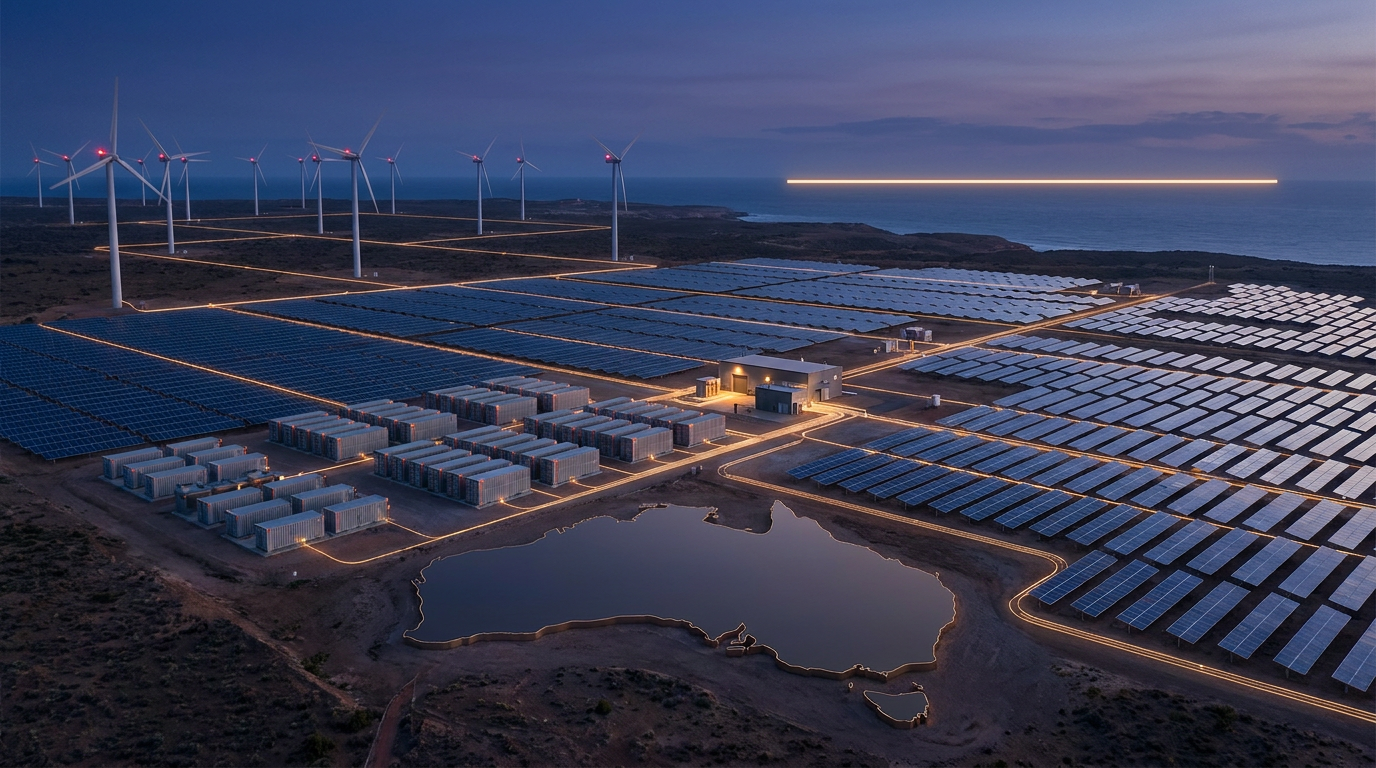
Original illustration created for RenewaNews.

Batteries Are Setting Wholesale Prices in 32% of NEM Intervals, Flattening the Evening Peak Australia Relied On
Battery charge and discharge activity set the wholesale price in 32% of all National Electricity Market trading intervals during the first quarter of 2026, according to the Australian Energy Market Operator's Quarterly Energy Dynamics report published April 30, 2026. That made storage the single most frequent price-setting technology in the grid for the first time, ahead of gas and hydro, on the back of 4,445 MW of new battery capacity added over the prior twelve months — more than doubling total installed capacity, AEMO said.
AEMO Executive General Manager Violette Mouchaileh described the mechanism plainly: batteries are "increasingly absorbing excess renewable energy during the day and shifting it into the market during evening peaks." The numbers behind that sentence are now piling up fast enough to change how developers underwrite new solar, wind and storage projects.
The evening peak is disappearing on schedule
The clearest evidence sits in the 5-9pm window that has anchored Australian power-price forecasting for a decade. Modo Energy's analysis, published April 28, 2026, found that batteries set the price in 46% of intervals during that evening block across the NEM in March 2026, up from 16% a year earlier. In New South Wales and Queensland, the battery-set share of evening-peak intervals topped 60%. Modo called this "the first clear sign that the battery fleet is structurally setting peak prices, not just trading around them" — a fleet large enough to be the marginal unit every evening, rather than one occasionally arbitraging around a scarcity price someone else sets.
Spreads have compressed, but the arithmetic behind one figure needs a caveat
Gridcog's analysis, published May 25, 2026, put a number on the revenue consequence: battery operators earned over 60% less in Autumn 2026 than in Autumn 2025, and over 80% less than in 2021. Gridcog did not specify whether that decline is measured per megawatt of installed capacity or across the fleet's total revenue — a distinction that matters, because the fleet has also roughly doubled in size over the same window, and it did not publish the base-period spread behind its claim of a 70% year-on-year fall in two-hour spreads, so that percentage cannot be independently checked from the material available. What it did report as raw figures: average afternoon peak prices of $80/MWh against midday troughs of $12/MWh, attributed to what it called "record-low intraday spreads" as the growing storage fleet smooths the peak it was built to capture.
Whatever the precise denominator, the direction lines up with Modo's evening-peak data and AEMO's own figures. Every new megawatt of storage that arbitrages the day-night price gap narrows that gap for the next megawatt behind it, and the NEM's buildout has been fast enough to compress its own opportunity within roughly a year of the capacity showing up.
System-wide prices are falling too
AEMO's Q2 2026 update, published July 28, 2026, shows the effect widening beyond the evening block: average NEM wholesale prices fell 47% year-on-year to $74/MWh, with Victoria down 60%. Grid-scale battery capacity passed 9 GW by the end of the June quarter, more than double its year-earlier level, and 14 new generation and storage projects totaling 3.9 GW reached full output in the same three months. RenewEconomy's separate reporting on the AEMO data found battery discharge into the evening peak more than tripled to 1,115 MW during Q1 2026, with big batteries displacing hydro as the grid's most frequent price-setter.
The Clean Energy Regulator's Quarterly Carbon Market Report, published June 12, 2026, found the government's Cheaper Home Batteries Program added 2.5 GWh of small-scale storage in the first quarter alone. Households are importing less and exporting more during the evening peak, the same window utility-scale batteries are already compressing.
Confirmation from the demand side
Energy One's formal market update to the ASX, dated May 21, 2026, corroborates AEMO's headline figure independently, stating that battery charge and discharge set prices in 32% of NEM intervals and calling storage a "central market-shaping asset." The company's note adds that as spreads widen between surplus and scarcity pricing, the economic value of flexible and controllable load is rising for large industrial consumers able to shift consumption within the day.
Grid-forming inverters and the next revenue stack
One claim in circulation is that Australia has overtaken the United Kingdom to become the world's third-
Sources
This article was reported from the following sources.
- Quarterly Energy Dynamics Q1 2026 — Australian Energy Market Operator (AEMO), 2026-04-30
- Renewables, batteries continue to reshape energy markets - AEMO Q2 2026 — Australian Energy Market Operator (AEMO), 2026-07-28
- Australia: How BESS is pushing down peak prices in the NEM — Modo Energy, 2026-04-28
- Australian Battery Revenue Under Pressure as NEM Spreads Hit Record Lows — Gridcog, 2026-05-25
- The Third-Largest Battery Storage Market in the World: What Australia's Rise Means for Developers and Investors — Pacific Green Technologies, 2026-08-17
- Batteries both big and small have reshaped the grid and forced wholesale prices down, AEMO says — RenewEconomy, 2026-04-30
- Quarterly Carbon Market Report March quarter 2026 — Clean Energy Regulator, 2026-06-12
- May Market Update - Energy One Limited (ASX:EOL) — Listcorp / ASX, 2026-05-21
- Australia shows how batteries are taking over the role of gas-fired power plants — E&C Index, 2026-08-29
- How batteries now set electricity prices in wholesale markets — Quartz, 2026-08-21